How to build work products to get jobsThe PM market is brutal—to differentiate, many are turning to the work product. Here's how to actually impress, instead of bungle your opportunity
The work product is one of the most underrated ways to get a job. In a world where PM job postings are down 91% compared to two years ago, you need to do something to stand out. And it works. 3 of the 6 laid off big tech PMs I helped get jobs last year used them. Since then, I’ve helped over 15 PMs and product leaders get jobs with this technique. But, the cat is out of the bag. This is what I heard from a hiring manager at Meta this week:
That’s not good! If you’re putting all the extra work in to a work product, you want it to perform for you. So, today, we’re going to help you do exactly that. Brought to You by BuildBetterToday’s post has no paywall. BuildBetter has sponsored today’s post. I met with Spencer, a former PM himself, 1:1 and was inspired by his passion. BuildBetter.ai is used by 21,000 product teams to record customer and internal calls and turn them into structured, actionable insights and deliverables.
The results? Decrease time to revenue by a whopping 50%. 15 hours per project finding insights over hundreds of calls (now powered by Signals), 1.5 hours saved per document (eg, PRD), and a 40% reduction in team meetings (because people trust BuildBetter). Sign up today at BuildBetter.ai and get 5 hours of recording free. Use code: AAKASH15 for 15% off for the first 3 months. Book a demo for an additional 5 hours free. Don’t want ads? Go paid to remove ads.Today’s PostWords: 6,544 | Est. Reading Time: 29 mins If you only have 1 minute…
1. An intro to work products1.1 Why you need this adviceI’ve been talking to a lot of aspiring PMs the past few weeks, and the thing that’s come up most often is: it’s damn hard to get an offer these days. The first thing I ask anyone when talking to them about job searching is their funnel. And this funnel was shared to me last Thursday by a PM with 9 years of experience:
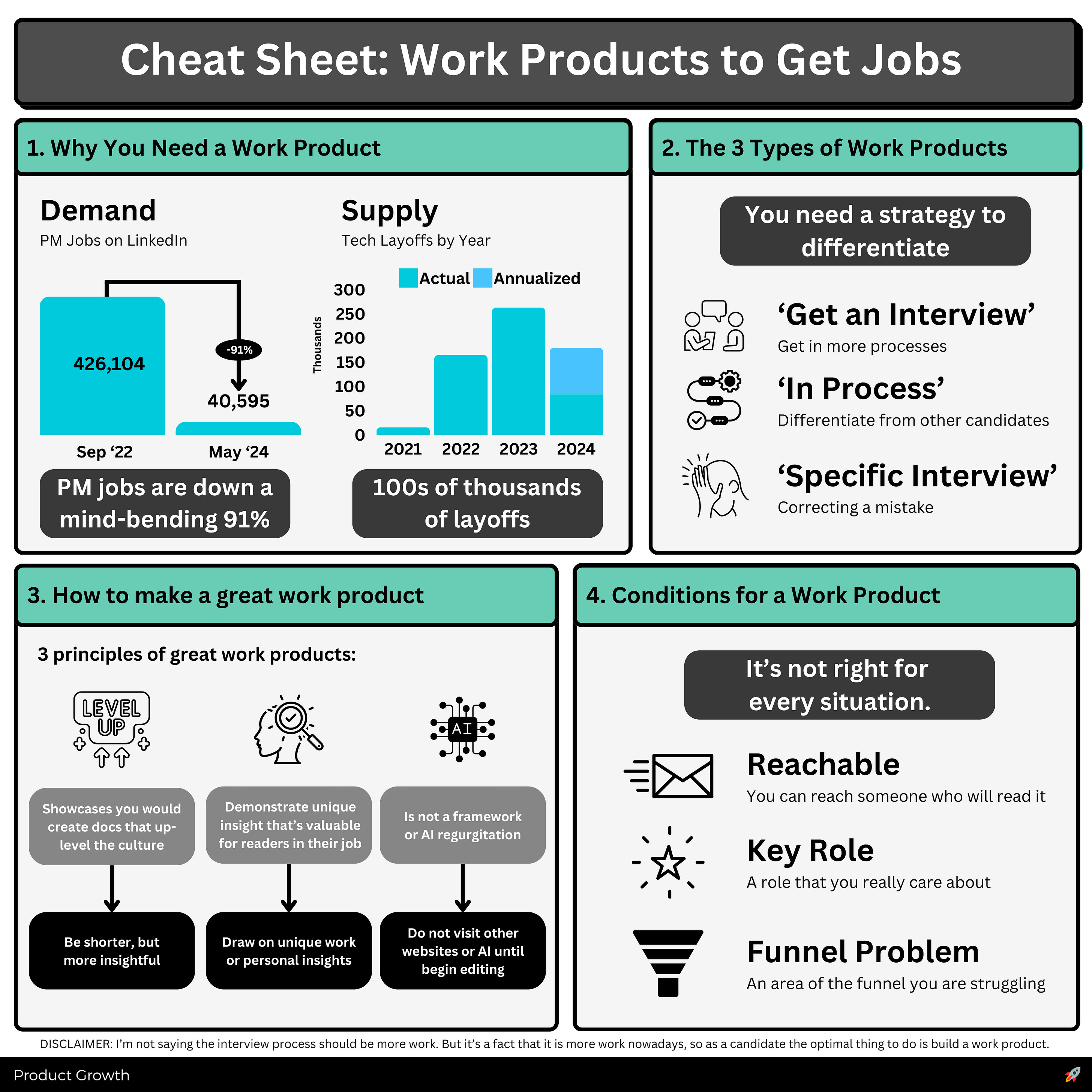
It’s a depressing drop. This same PM has never spent a day on the job market before this, because every job in her career landed in her lap while she was in another job. But when I asked her if she’d submitted any work products? The answer was no. My first inclination was: you need to do more of this! Here’s why: your competition is. So, you actually are at a disadvantage if you’re not. Disclaimer: I’m not saying the interview process should be more workYes, I know this is a ton of work in an already soul-sucking process. I’m not saying it’s a good thing it’s come to this. It’s come to this because of supply and demand. Demand for PM jobs is down. Supply of qualified PMs is up. In the real world that we live in, the strictly dominant move from PMs is to get jobs with work products—and outshine those who don’t. 1.2 The three types of work productsHere’s what I explained to that PM about the three types of work products to consider. PSA: One-size fits all doesn’t workA lot of people I’ve talked to have tried to the ‘industry report’ strategy. The idea is:
Nobody wants you essentially shopping around a blog post or slide deck to get a job. For everyone I’ve talked to, this strategy hasn’t worked. Instead, I’ve found that very specific work products work best. The fact is: it shouldn’t seem like you’ve created this work product for anyone else but that person. Focus on these three types insteadThese are the three cases where you would create a bespoke work product:
This doesn’t include assignments they give you during the process. I’ve done a post on that. When to use which work productYou might not have any idea what any of these things mean. Let’s break down when to employ these tactics.
1.3 Why work products work—and how to play into thatBefore we move there, though, let’s double-click into that Meta hiring manager at the beginning. They’re getting sent work products, but these are used to disqualify more people than they qualify. What’s going on here?
So, if we flip these, we can create three principles of great work products:
These give us principles to lean on as we go through creating our own work products:
Playing deeply into the principles in these ways will enable us to create a work product that doesn’t disqualify, it wows. Normally, the piece would be paywalled at this point. This piece is not paywalled thanks to BuildBetter! Be sure to check them out, and upgrade to the paid newsletter if you want more content like this: 2. Building work products together2.1 ‘Get an Interview’ work productToday’s Scenario(This is a fictionalized scenario of a real candidate and work product.) So let’s begin with type 1, the ‘get an interview’ work product. Meet Kai Gutierrez. After graduating from UCSD, Kai was a software engineer for 3 years. Then, he became a PM - first at the small biotech startup he was working, and then for 2 years at Tesla. Unfortunately, a few weeks ago, he was unexpectedly hit by the layoffs at Tesla. After working 90 hour weeks, he was definitely surprised by the news. And he’s determined to get his next job at a similar brand name to Tesla - only this time, he’s not going to get laid off. So, he made his layoff post, and immediately got to applying to jobs. After a swell of interviews from his layoff post, though, he hasn’t been able to secure a single interview. In fact, he’s been ghosted over 50 job applications. A big part of the problem is Kai only want to work at the ~50 companies in the world that have a similar brand name to Tesla. This is a great scenario where a work product comes in.
Choosing who to Work Product forYou don’t want to spend a bunch of time on a work product only for no one to respond. So the first task in building a work product is finding someone who:
This is actually not easy. So Kai gets to searching. In the end, he finds someone who looks like a good target:
This gives Kai enough information to say, “okay, Jamie, I’m going to create something for you.” The idea? He’ll send her an InMail with the work product linked. Creating the work productHaving worked on the onboard software for Tesla, Kai has learned a thing or two about what users care about. On the other hand, the Hummer team has done far fewer sales and is more used to a traditional GM buyer. So, he realizes her can share unique insight to Jamie by sharing unique learnings from his time on the Tesla onboard software. Going a layer deeper: Kai worked in the specific areas of entertainment and performance. It looks like Jame owns the entire on board software team. But the Hummer team has barely implemented any entertainment features. There’s no video viewing, no video games, no internet browsing. He sees his opportunity: he’ll put together a quick Notion document sharing insights from his time working entertainment to answer the question ‘Should the Hummer On Board Team Invest in Entertainment?’ He time-boxed 1 hour. And this is what he came up with: Should the Hummer On Board Team Invest in Entertainment?Executive SummaryThe Hummer EV has an untapped opportunity to outshine luxury SUV competitors like Audi e-tron, Tesla Model X, and Volvo XC90 Recharge by offering a best-in-class in-vehicle entertainment suite. Investing in entertainment features is projected to increase Hummer EV's NPS by 4-7 points, driving an estimated 3,000 incremental sales annually and unlocking $10M+ in yearly subscription revenue. This document outlines the key entertainment features to prioritize, the engineering and cost considerations, a phased rollout plan, and next steps. Why Listen to Me?
Understanding the Hummer EV BuyerHummer EV buyers are affluent ($175k+ HHI), fun-loving thrill-seekers who value prestige, power and having the latest tech (Hummer EV Owner Study, 2023). While Tesla buyers tend to be efficiency-minded early adopters, Hummer customers are experience-driven and willing to splurge on upgrades that amp up the fun factor. "If I pull up in my Hummer EV, everyone takes notice. I'm here to make a statement and have a blast while doing it." - Hummer EV Owner, Chicago Hummer EV Entertainment RoadmapPhased approach balancing buyer desirability with engineering effort: Phase 1 (H2 2024)
Phase 2 (H1 2025)
Phase 3 (H2 2025)
Key dependencies: upgrading to Qualcomm Snapdragon Auto Cockpit Platform (adds ~$45/vehicle) in 2024 models to support graphics-intensive features. Trade-Offs to Consider
Opportunity SizingIncreasing Hummer EV's NPS from 56 to 60 (comparable to Tesla's 7 point entertainment-driven NPS boost) is expected to generate 200 additional sales annually (3.5x the cost of increased chips based on 50K sales) alone. If we also add subscriptions, e.g. a $19.99/mo subscription after 12 months free:
Ancillary benefits include halo effect increasing EV consideration and monetization upside from in-app purchases. Next Steps
Why This WorksI hope you enjoyed Kai’s work product! I think this is the type of thing that would do well. It demonstrates:
It's as if Kai wrote a bespoke roadmap for Jamie and her team. It’s showing he can develop the type of work product that Jamie would need from him. And it gives no sniff of AI-ness anywhere. How Kai Packages it UpThe day Kai found Jamie on LinkedIn, he sent her a personalized LinkedIn invite with the short message, “Love to connect with onboard software PMs in the industry.” She accepted! So he doesn’t even have to spend a InMail credit on this Direct Message. (But he would have, by paying for LinkedIn Premium, if she didn’t accept.) So he sends her the following message:
ResultsIt turns out Jamie didn’t respond for 72 hours, so Kai just recorded a quick 2 minute loom summarizing the document:
And then she responded. That’s the approach I’d recommend for ‘getting an interview'. Notice that while it took some effort, the time investment was reasonable:
It wasn’t like Kai went and spent 6 hours on something that Jamie may never read. He spent some time on it, but it could help him get the job. And it’s a job he’s clearly qualified for. Plus - it was kinda fun! The Risks With ThisThere are a few risks here:
Overall, all the risks are addressable - and the time investment was not that bad. It’s definitely worth a try if you’re in a situation similar to Kai. 2.2 ‘In Process’ work productThe Scenario(Again, most of the details here are real. Just enough are fictionalized.) Meet Radhika Patel. She’s been a PM for 7 years, but the last 3 years she’s sat on her hands. She’s working at Amazon, but it’s hard as hell. Since the rounds of layoffs, she’s been working harder than ever. And not accepting the steady stream of inbound interest she’s starting to get again. But, now she’s ready. She’s popped her head up for her dream role that the recruiter reached out to her for: the AI implementation of Gemini in GSuite. She’s always admired how Google seemed to treat its employees better, and she thinks they’re one of the few companies who can match her TC. Plus, she wants to break into AI. So she decides it might be a good time for an in process work product. It’s a great time:
Choosing the Work ProductRadhika has made it past the recruiter and the hiring manager. Next up is several more onsite rounds. So she’s thinking she can use this work product as a way to impress the hiring manager. She decides she wants to write a PRD on an aspect of Gemini’s GSuite implementation. Part of her prior work at Amazon was on Alexa, so she decides to double click on that. This is an area where she can show some unique insights. And the goal is not to get in a depth of detail race with other PMs. It’s to showcase her unique skills. Here’s what she comes up with after 1.5 hours of time boxing: Product Spec Proposal: Gemini-Powered Voice Assistant for Gmailtl;drDevelop a Gemini-Powered Voice Assistant for Gmail that transcribes voice inputs accurately, understands context, and composes high-quality, trustworthy email responses to enhance user productivity and satisfaction. Why listen to me? As a PM on Amazon’s Alexa, I’ve been working on the e-mail space for quite some time. In fact, we find that >12% of Alexa actions are now e-mails, up 200% from 3 years ago when I started. Problem Statement
The result is users can’t leverage the power of LLMs with their voice. They either type to use the LLM or use their voice for transcription. Gmail users need a voice assistant that not just accurately transcribes, but understands context, recalls relevant info, and composes coherent responses users can trust. GoalsUser Goals:
Business Goals:
Non-Goals:
User StoriesPersona: Business Development ManagerStory: Alex, a Business Development Manager, is preparing for an important client meeting. He needs to send a follow-up email to recap next steps and confirm the client's interest. With Gemini Voice for Gmail, Alex simply says: "Compose an email to John to make sure he's excited for our meeting tomorrow."
Persona: Customer Support LeadStory: Emily, a Customer Support Lead, is handling a complex customer escalation. She needs to send a detailed reply addressing multiple issues and outlining the resolution steps. Pressed for time, Emily uses Gemini Voice: "Compose an email response to Karen addressing her billing issue, feature request, and support complaint. Apologize for the delay, explain the resolution steps, and offer a goodwill credit." Gemini Action: Gemini analyzes the customer's email and the support ticket history, uses its knowledge base to then generate a comprehensive reply.
Pricing and PackagingPursue a free for consumers strategy to encourage adoption and stickiness of Gmail. This will have a cost in inference computation and will need to be weighed carefully. Use the free for users to get enterprise customers to pay and also adopt Gemini voice APIs. This is where the revenue will be earned back in multiples. Competitive LandscapeThere’s an opportunity for Gmail + Gemini Voice to leapfrog competitors with human-like email composition, context awareness, and privacy-centric user controls.
Key Use Cases for Phase 1Prioritized most important use cases:
User ExperienceWe envision 3 key elements of the UX (to be confirmed in design exploration phase):
Technical Considerations
Key Features (Phased)Phase 1:
Phase 2:
Phase 3:
Go-To-Market Plan
Success MetricsOutput Quality:
Engagement:
Productivity:
Trust:
Business Impact:
Privacy & Security
Phases to GA
Why Gemini?Gemini's groundbreaking language models, trained on web-scale data, bring unprecedented linguistic understanding and generation to email. Proprietary few-shot learning and RLHF techniques enable rapid personalization. Built-in privacy safeguards, adversarial training, and human oversight instill user trust. Enterprise-grade security and compliance features appeal to businesses. Gemini's scalable inference architecture enables more parameters and compute per request vs. competitors, powering richer interactions. But that has been mostly locked behind a Gemini Advanced subscription. Now it will be more widely available. If this is successful…Gemini Voice in Gmail can be just the beginning. The same voice assistant technology can expand across all of Google Workspace, unlocking transformative productivity gains. It showcases the strategic power of Gemini as an end-to-end AI platform for building trustworthy, user-aligned language products. Why this worksRadhika's work product succeeds on several fronts:
It’s a fun little preview for the hiring manager of the type of features that Radhika could lead given her expertise in voice assistants. So, it’s not likely someone else chose this exact feature and developed a better PRD. Worst case, compared to candidates who didn’t do this work, it shows Radhika really cares about the role. (If you’re wondering how Aakash/Radhika wrote this PRD in 1.5 hours, check out his PRD guide.) How Radhika packages itRadhika had the interview with the hiring manager, and they both already exchanged Thank You’s. So she decided to reply in that thread itself:
In the example that we’ve fictionalized, Radhika got the role - and joined Google. The hiring manager had this to stay after she started:
2.3 ‘Specific Interview’ work productThe final scenarioLet’s end with a final scenario that a work product really makes sense: you’ve gone and messed up an interview. It happens to the best of us. Let’s take an example that one of my mentees faces late last year.
Now her options were kind of limited. She may have lost the interview entirely. But, actually, she felt they were on the edge. So, she decided: why not take some time to enhance my chances? Choosing a work productMy mentee and I brainstormed a few options:
Ultimately, we decided to work on a problem exploration document that would show she doesn’t normally jump into solutions. Starting with the packagingBefore jumping into the work product we actually worked on packaging it so we could go backwards:
So now that we knew what we were trying to show, I let her create the doc. She ended up creating something like this: Problem Space Exploration: RobinhoodIn our interview, I chose Robinhood as my favorite product. When asked how I would improve it, I immediately started proposing solutions without first thoroughly exploring and framing the problem space. This document outlines the approach I would typically take to deeply understand the problem space before generating solutions. 1 - Analyze Key Metrics to Assess Current State
2 - Rigorous User Research to Uncover Pain Points
3 - Comprehensive Competitive Analysis
4 - Align with Internal Stakeholders and Company Strategy
5 - Synthesize Problems and Define Opportunities
Next Steps
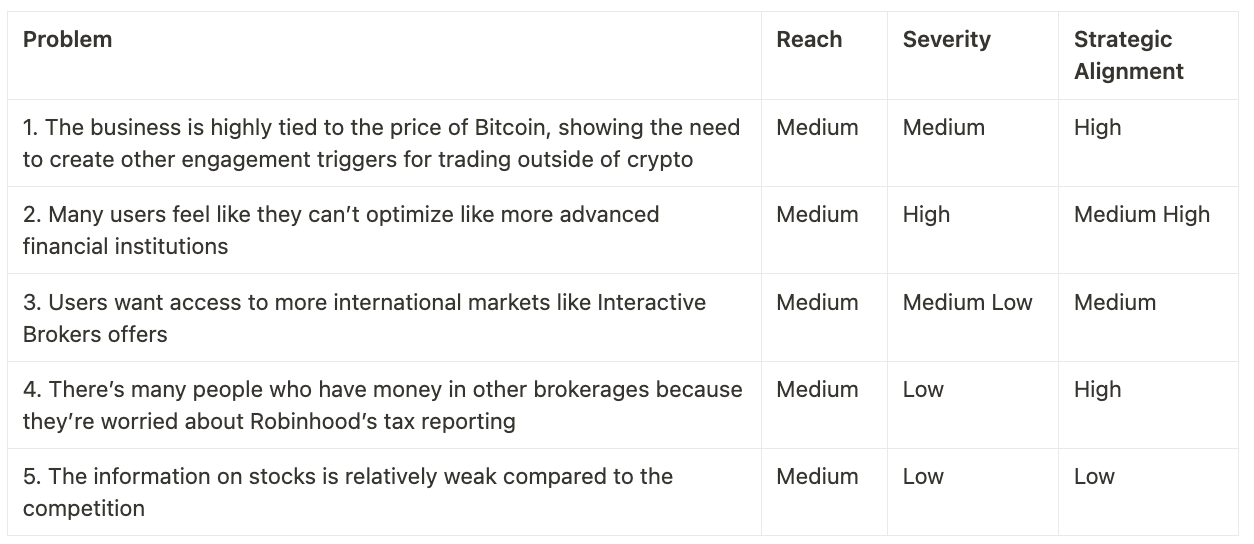
What This Might Have Looked Like in an InterviewIf we were to simulate through such a process, we might imagine that several themes emerge as potential opportunity areas, like:
From there, I would try to prioritize. In an interview setting, we could prioritize problems that: reach a lot of people, are severe, and align to the strategy.
Based on this quick prioritization, we’d prioritize that users feel like they can’t optimize like more advanced financial institutions. After prioritizing these problems, I’d work through solution exploration: features like Sharpe ratio, automate rebalancing, and other objective functions. Of course, the actual problem space exploration and prioritization would be more thorough in real life. I hope that gives a better overview of my process! Why this WorksThis document is not too long, and it shows the candidate does not necessarily have the gap they showed in the interview. It kind of relates to everyone’s ability to go too quickly on an interview. For my mentee, a document like this made a real difference. The interviewer replied:
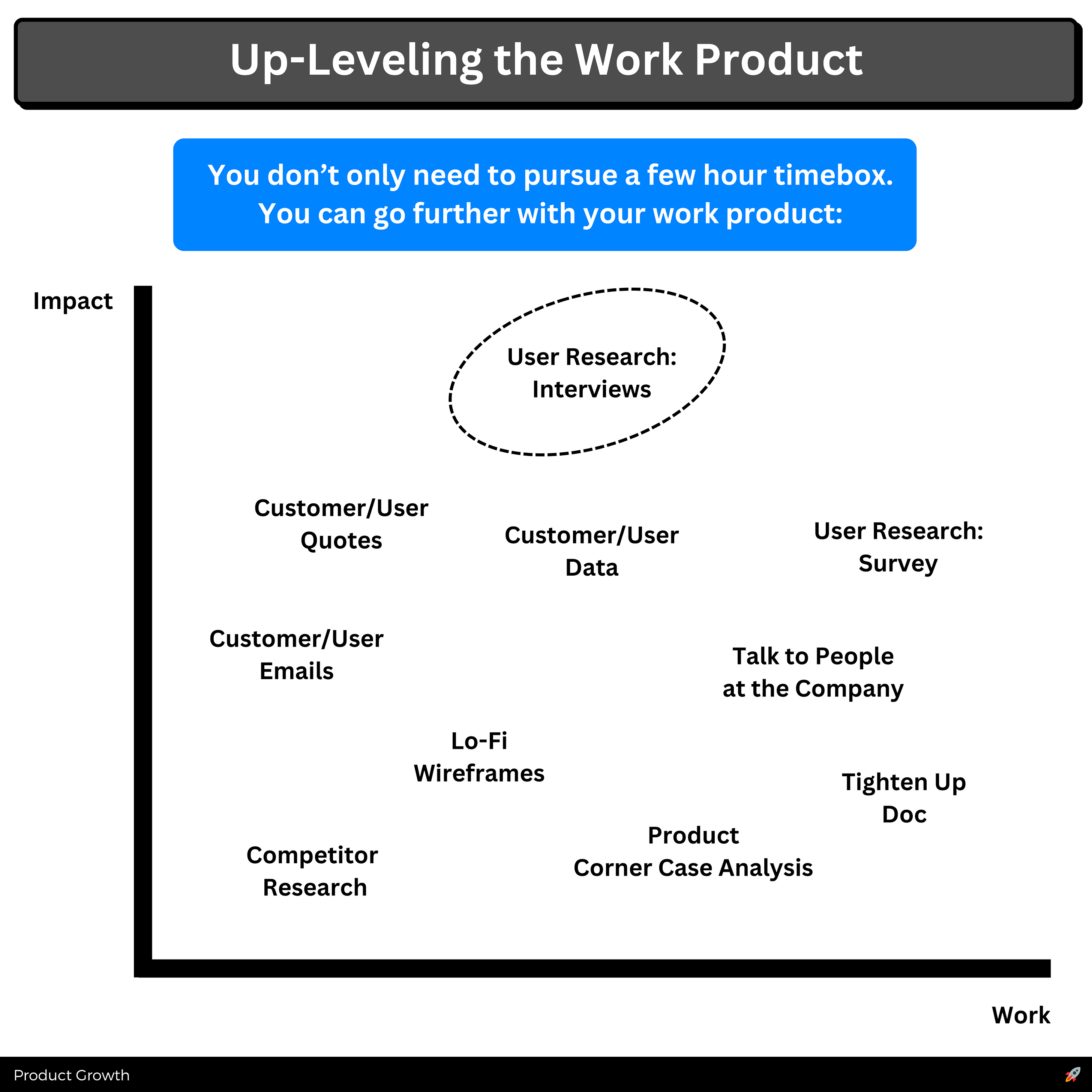
And she moved on to the next round. It worked. 3. How to up-level these furtherIn this post, we’ve gone through highly tactical and achievable work products. These show extra effort against our peers and potentially wow the hiring manager. But what if you want to go even further? Some people just want to do a few interview processes and secure all of them. These documents were all done in quick, time boxed blocks. But you could go further (in fact, in the past, I have). These are the main ways to extend the work product:
Make personal decisions about whether to do these. Here’s how I would rank them: Worthwhile if you have time
Only for things you really love:
Just too much work:
Key Takeaways
Final WordsAnd that’s it for work products! I hope these real stories that have been fictionalized, and the example documents, give you a better idea of what you need to build. These techniques work. So go out and get your jobs - just don’t send stuff that actually disqualifies you.
Thanks again to BuildBetter.ai for partnering on this post buy-out.
Up NextAakash here—As promised, I’m going to pick up the posting cadence to write about more things at less depth. Here’s what I have planned next:
See you then, Aakash Invite your friends and earn rewardsIf you enjoy Product Growth, share it with your friends and earn rewards when they subscribe.
|




This week’s system design refresher: Top 9 Most Popular API Protocols (Youtube video) What is a deadlock? What’s the difference between Session-based authentication and JWTs? Top 6 ElasticSearch Use Cases Top 9 Cases Behind 100% CPU Usage SPONSOR US ͏ ͏ ͏ ͏ ͏ ͏ ͏ ͏ ͏ ͏ ͏ ͏ ͏ ͏ ͏ ͏ ͏ ͏ ͏ ͏ ͏ ͏ ͏ ͏ ͏ ͏ ͏ ͏ ...
Comments
Post a Comment