Fractional Product Leadership: Your Step-By-Step GuideHow to become, and succeed at one of the most intriguing product jobs - the fractional VP of Product or CPO. Insights from 20 interviews
It might be the hottest job in the product world right now - the fractional CPO. On LinkedIn, it seems like just about everyone wants to be one. But few know how to become one. At least sustainably. It might seem obvious that you could get 1-2 clients from your network. But a consistent pipeline? That seems much more daunting. In today’s post, we’re going to give you the step-by-step guide on how to not just become a fractional CPO or VP of Product, but make your living as one. Introducing Jason
Jason is a fractional product leader, coach and consultant himself, host of the One Knight in Product podcast, and One Knight in Product newsletter. You might know him from one of his killer PM memes. Today’s PostWords: 16,144 | Est. Reading Time: 73 mins We’ve talked to 20 real-life fractional PMs/ product leaders/ execs to get you a holistic ‘how to’ on the career:
If you only have 1 minute…
Now, let’s add a whole lot of texture to that. It’s a long piece, filled with quotes, that might get cut off your e-mail client. You may want to migrate to the web: 1. Fractional Product Leader 101Nothing stays the same in the world of startups and scale-ups for long. Recently, a new breed of product leader has emerged: the fractional one.
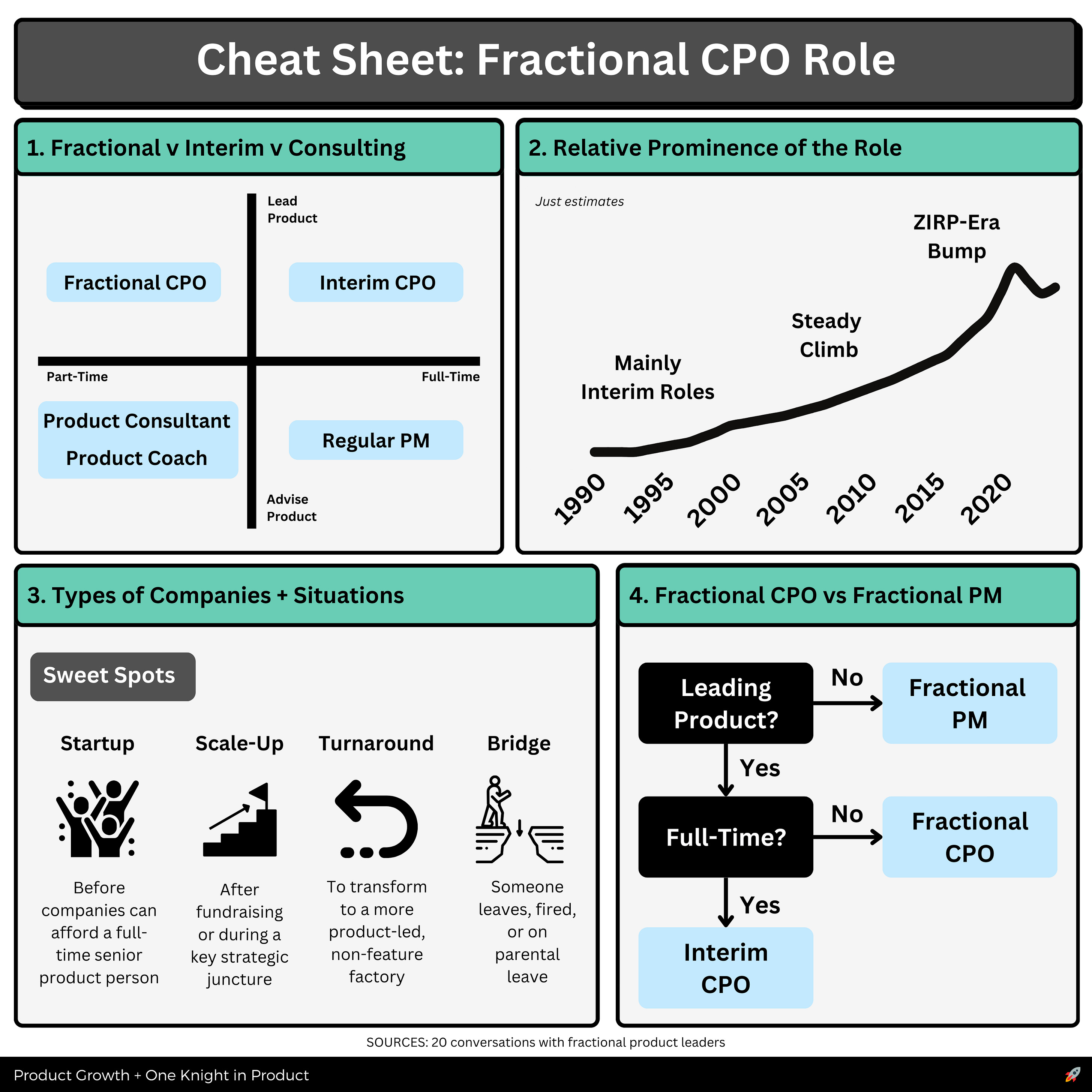
But what exactly is a fractional product leader, and how do they differ from their interim and consultant counterparts? 1.1 Interim v Fractional v ConsultantBefore we explore the world of fractional product leadership, it's important to understand the different types of non-traditional product leadership roles. Each has its own unique characteristics, advantages, and challenges. 1.1.1 Interim Leaders: Full-Time, Short-TermInterim leaders step into a full-time role for a limited time, fully immersed in day-to-day operations. They're there to bridge the gap, keep things running smoothly, and then pass the baton.
—Sergio Pereira, Fractional CTO and CPO since 2015 Interim leaders are often brought in during times of transition or crisis, when a sudden vacancy needs to be filled. They provide stability and keep the product moving forward until a permanent leader can be found.
—Harpal Singh, Fractional since 2013 Another scenario for interim is if someone goes on maternity or paternity leave. This is especially common in Europe, where those leaves are longer. Because they're fully embedded in the organization, interim leaders have the opportunity to make a significant impact in a short amount of time. 1.1.2 Consultants and Coaches: Targeted and StrategicConsultants and coaches bring a different approach to product management. They're brought in to provide targeted expertise and strategic guidance, rather than day-to-day operational leadership. Consultants are often brought in to solve a specific problem or to bring a fresh perspective to a challenge the company is facing.
—Nadia Tosheva, Fractional since 2019 Coaches, on the other hand, come to focus on individuals, not the company as a whole. There is a lot of debate around what a “product coach” really means.
In any case, coaches work with individuals or groups to help make them make progress in their careers. And, for some people exploring fractional roles, it turns out that this is exactly what they really want to spend their time on.
—Nesrine Changuel, Product Coach and Former Senior PM at Google On the other hand, many of the fractional leaders we spoke to also offer coaching on the side, as part of a portfolio of contracts. It can fit in nicely between the cracks. As an example, both Aakash and Jason are active coaches alongside their other work. 1.1.3 Fractional Leaders: Adaptive and EmbeddedFractional leadership can combine elements of both interim leadership and consulting. Fractional leaders are adaptive and embedded, filling gaps in the product organization while providing strategic guidance. Unlike interim leaders, fractional leaders are generally not full-time employees. They typically work on a retainer basis, dedicating a set number of hours per week or month to the company.
—Sergio Pereira, Fractional CTO and CPO since 2015 Fractional leaders are often brought in when a company needs product leadership but isn't ready for a full-time hire. They can help bridge the gap between the founder-led product era and the hiring of a full-time product leader. Another common use case is when a more established non-product organization is trying to kick start their product transformation and need someone to come in and set things moving (and potentially hire another, full-time person once the initial work is done).
—Sarah Timms, Fractional since 2016 Some key attributes of a successful fractional leader include:
Every company is different, with its own unique culture, challenges, and opportunities. Fractional leaders need to be able to quickly assess the situation and determine where they can add the most value. But fractional leaders aren't trying to do it all. They're strategic about where they focus their energy.
—Dave Martin, Fractional since 2015 Generally, the ultimate goal of a fractional engagement is often (but not always) to work yourself out of a job by helping the company reach a point where they can bring on a full-time leader.
—Sergio Pereira, Fractional CTO and CPO since 2015 1.1.4 Choosing the Right FitSo how do you choose between interim, fractional, and consulting roles? It all comes down to your skills, preferences, and career goals, as well as the needs of the organization. You will need to be able to demonstrate significant experience at the level you are aiming for. Generally, when it comes to the different types of roles you could go for, consider that: Interim roles are best for people who…
Consulting & coaching roles are best for people who…
Fractional roles are best for people who…
It’s also fair to say that, depending on the terms of your engagement, you may find some of these aspects common across the board. Ultimately, the right fit will depend on your skills, experience, and career goals, as well as the needs and culture of your potential clients. And here’s the thing: you can always pursue a mix. (We’ll discuss this more in section 2.) 1.2 History of the RoleNow that we understand the different types of non-traditional product leadership roles, let's explore how the fractional model came to be. Consulting has been around since the dawn of commerce. And fractional accounting roles has been around for centuries. But it's only in the last few decades that fractional work has extended into other domains. We break this down into 5 specific time periods: 1.2.1 ERA 1 - The Early DaysThe concept of fractional product leadership started to gain traction in the 90s. From the people we talked to, those were the earliest signs:
—Jeanette Cajide, Interim/ Fractional COO & CPO since 2009
—Rich Mironov, Interim/Fractional Product Leader since 2001 At the time, the idea of a part-time or temporary product leader was still novel. Companies were used to hiring full-time, permanent employees for these roles. But as the startup ecosystem began to mature, companies started to see the value in bringing in experienced product leaders on a part-time or project basis. They realized that they could get the expertise they needed without the long-term commitment or cost of a full-time hire. 1.2.2 ERA 2 - The Rise of the Fractional CTOOne of the first R&D roles to really embrace the fractional model was the CTO.
—Sergio Pereira, Fractional CTO and CPO since 2015 Startups often need technical leadership, but they may not have the budget or the need for a full-time CTO. Bringing in a fractional CTO allows them to get the strategic guidance they need, while still being mindful of their resources. The success of the fractional CTO model paved the way for other fractional C-suite roles, including the fractional CPO. People loved how execution-oriented fractional roles are.
—Jeanette Cajide, Interim/ Fractional COO & CPO since 2009 1.2.3 ERA 3 - Overcoming SkepticismDespite the early success of fractional CTOs, the idea of a fractional product leader was still met with skepticism in some circles.
—Harpal Singh, Fractional since 2013 There was a belief that product leadership was too integral to the company to be done by an outsider. How could someone who wasn't fully embedded in the organization possibly provide effective product leadership? But as more and more companies began to experiment with fractional product roles, they started to see the value. They realized that an experienced product leader could provide significant value, even on a part-time or project basis.
—Harpal Singh, Fractional since 2013 This shift in mindset opened the door for the fractional product leader role to really take off. 1.2.4 ERA 4 - The ZIRP EraThe fractional model really hit its stride in the latest zero interest rate policy (ZIRP) era. With easy access to capital, startups were growing faster than ever before. They needed experienced product leadership to help them scale, but they often couldn't justify a full-time hire. Fractional product leaders were the perfect solution. They could provide the expertise and guidance startups needed, without the long-term commitment or cost. 1.2.5 ERA 5 - Post-ZIRPInterestingly, the end of ZIRP hasn’t had the same effect on fractional roles as it has had on full-time roles. Because in a post-ZIRP world, with tighter budgets and slowing growth, some full-time roles convert to fractional. Companies are realizing that fractional roles can provide a level of flexibility and expertise that's hard to find in a full-time hire. So, there has been a decline, but a small one. It’s not just fractional product, either. The overall fractional market is doing well, supported by continued growth in CFOs and CMOs.
—Sergio Pereira, Fractional CTO and CPO since 2015 This returns back to the first chapter of our history. Those roles that created fractional are sustaining it. But, the overall mood suggests that the fractional model is not just a passing trend, but a fundamental shift in how companies think about leadership roles. And as the overall business world continues to evolve, the demand for fractional product leadership is likely to only continue to grow. 1.3 Market for Fractional Leaders and PayAs the demand for fractional product leaders continues to grow, the market is becoming more established and diverse. In this section, we’ll break down the most common markets for fractional leaders, the rise of fractional agencies, compensation to expect, and the challenges of the market. 1.3.1 The Most Common Markets for Fractional LeadersThe Early-Stage Startup Sweet SpotOne of the most compelling markets for fractional product leaders is early-stage startups. These companies often need the expertise of a seasoned product leader, but may not have the resources or the need for a full-time chief product officer (CPO). Early-stage startups, particularly those at the Series A or B stage, are often at a critical inflection point:
This is where a fractional product leader can be invaluable. They can provide the strategic guidance and hands-on execution that startups need to navigate this challenging phase.
—Ed Biden, Former Guest Author, Fractional since 2022 Fractional product leaders can help startups in a multitude of ways. But these 4 situations are especially common:
It’s a simple value proposition: fractional product leaders bring the expertise and experience of a seasoned product executive, but at a fraction of the cost of a full-time hire.
—Dave Martin, Fractional since 2015 This service-market fit has created a good market for roles in early-stage startups. Beyond Startups: A Broader MarketWhile early-stage startups are a natural fit for fractional product leaders, the market extends far beyond just startups. Even larger, more established companies are starting to bring in fractional leaders for specific initiatives or to supplement their existing product teams.
—Rich Mironov, Interim/Fractional Product Leader since 2001 There are several scenarios where a larger company might benefit from a fractional product leader, but these are the 5 we heard most often:
As you can guess by all these scenarios, this broader job market of May 2024 presents a significant opportunity for fractional product leaders. With all the layoffs and product turnover, every product org has one of those ailments it seems. The bigger company trend is new, but spreading. And both sides have incentive to:
1.3.2 The Emergence of Fractional Product AgenciesAs the market for fractional product leadership grows, we're starting to see the emergence of dedicated fractional product agencies. These firms specialize in providing fractional product leadership services to companies. Some notable examples include: These agencies operate on a similar model to traditional consulting firms, but with a specific focus on product leadership. They have a roster of experienced product executives that they match with client companies based on their specific needs and challenges. For companies, working with a fractional product agency can simplify the process of finding and engaging a fractional leader.
For fractional product leaders, Joining an agency can provide a steadier stream of projects and income. It can also provide a community of peers and support for the administrative and business development aspects of fractional work. Being part of an organization can give you a built-in support and collaboration network, and make you feel less alone on your journey.
—Emilie Lindström, Fractional Product Consultant at Value Rebels However, working with an agency also means giving up some autonomy and a portion of your billings. Fractional leaders need to weigh these trade-offs against the benefits of independent work. As the fractional model continues to gain traction, we can expect to see this ecosystem continue to mature and expand. 1.3.3 Compensation: Rates and FactorsOne of the most common questions prospective fractional product leaders have is, "How much can I expect to earn?" As with many aspects of fractional work, the answer is, "It depends." Globally, rates can range from $100-$1500/day. 5 main factors determine where you end up within that:
If you really want some general benchmarks for fractional product leader rates, here’s what you’ll want to keep in mind:
It’s the basic spread of tech investment.
—Sergio Pereira, Fractional CTO and CPO since 2015 The way to make sense of it all is that: most people are charging a higher day rate than an equivalent full-time role. Take your market, and bump the rate about 40%.
—Rich Mironov, Interim/Fractional Product Leader since 2001 The way to command those higher rates? Definitely develop a specialization or niche. This could be deep expertise in a particular industry, a type of product, or a stage of company.
—Sergio Pereira, Fractional CTO and CPO since 2015 By becoming the go-to expert in a specific area, fractional leaders can differentiate themselves in the market and justify higher rates. However, specialization also means narrowing your potential client base, so it's a trade-off that each fractional leader needs to weigh for themselves. The basic rhythm is that consultants and fractionals start off wide and have to take just about anything but, over time, they start to niche down. It’s generally seen as a bad sign if freelancers don’t niche down once they’ve found their feet. 1.3.4 The Challenges of the Fractional MarketDo these rates mean you are rich? Not exactly. Despite the growth and opportunity in the fractional product leadership market, it's not without its challenges. If you’re in the US, you have to pay for benefits and employer’s tax. Plus, wherever you are, one of the biggest challenges is the variability and unpredictability of work. Unlike a traditional full-time job, fractional leaders don't have a guaranteed steady paycheck. They need to constantly hustle to line up their next project or client. This hustle can be especially challenging in an economic downturn, when companies may be tightening their budgets and cutting back on external spending.
—Nadia Tosheva, Fractional since 2019 You have to build a cushion for these gaps between projects. In general, fractionals we talked to earned slightly less, or up to, how much they used to earn full-time. They trade further income for much greater flexibility, variety, and the pleasure of doing their own thing. Another challenge is the increasing competition in the fractional market.
—Nadia Tosheva, Fractional since 2019 As more product leaders turn to fractional work, either by choice or necessity, the market is becoming more crowded. This can make it harder for individual leaders to stand out and secure clients. Despite these challenges, the outlook for the fractional product leadership market remains strong. As more and more companies recognize the value of flexible, expert leadership, the demand for fractional product leaders is only set to grow. For those who can navigate the challenges and deliver real value to their clients, fractional product leadership can be a rewarding and lucrative career path. It offers the opportunity to work with a diverse range of companies, but on your terms. Read on for your full toolkit of resources—including key channels to get clients, terms and conditions, and 7 full-length interviews. Most people would charge you $500+ for this:... Keep reading with a 7-day free trialSubscribe to Product Growth to keep reading this post and get 7 days of free access to the full post archives. A subscription gets you:
|






This week’s system design refresher: Top 9 Most Popular API Protocols (Youtube video) What is a deadlock? What’s the difference between Session-based authentication and JWTs? Top 6 ElasticSearch Use Cases Top 9 Cases Behind 100% CPU Usage SPONSOR US ͏ ͏ ͏ ͏ ͏ ͏ ͏ ͏ ͏ ͏ ͏ ͏ ͏ ͏ ͏ ͏ ͏ ͏ ͏ ͏ ͏ ͏ ͏ ͏ ͏ ͏ ͏ ͏ ...
Comments
Post a Comment