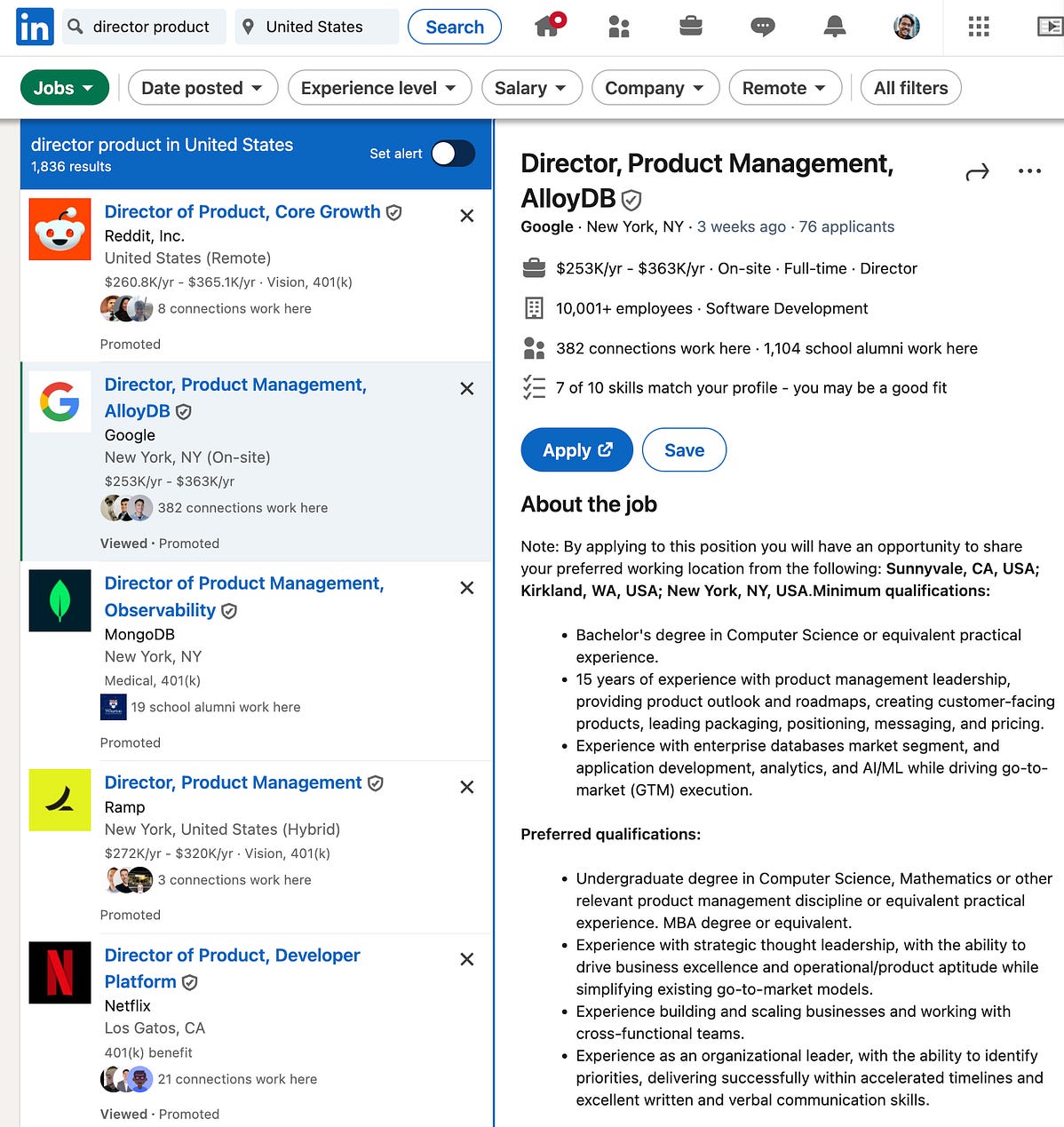
The job market is finally opening upRight now, Director of Product opportunities are being promoted on LinkedIn at Reddit, Google, MongoDB, Meta, Ramp, Netflix, and many more…
The sexiest, highest paying companies in tech are hiring leaders again. Folks who have been unemployed for several months, or were sitting tight for the last few years, are landing jobs they consider upgrades. It’s not just a “so-so” market. It’s heating up. Of the 12 product leaders talked to for this piece, 7 have been regularly receiving recruiter outreach messages. Given the new state of the market, I thought it would be the perfect time to discuss the critical meta that should govern a product leadership job search. Introducing Colin LernellWho better to write with than someone who has done that job search many times? I’m excited to introduce Colin Lernell. Colin has been a Senior Director of Product at Patreon, Noom, and Udacity. He has also landed offers for roles as a public company VP, a big tech Director, and an early stage CPO.
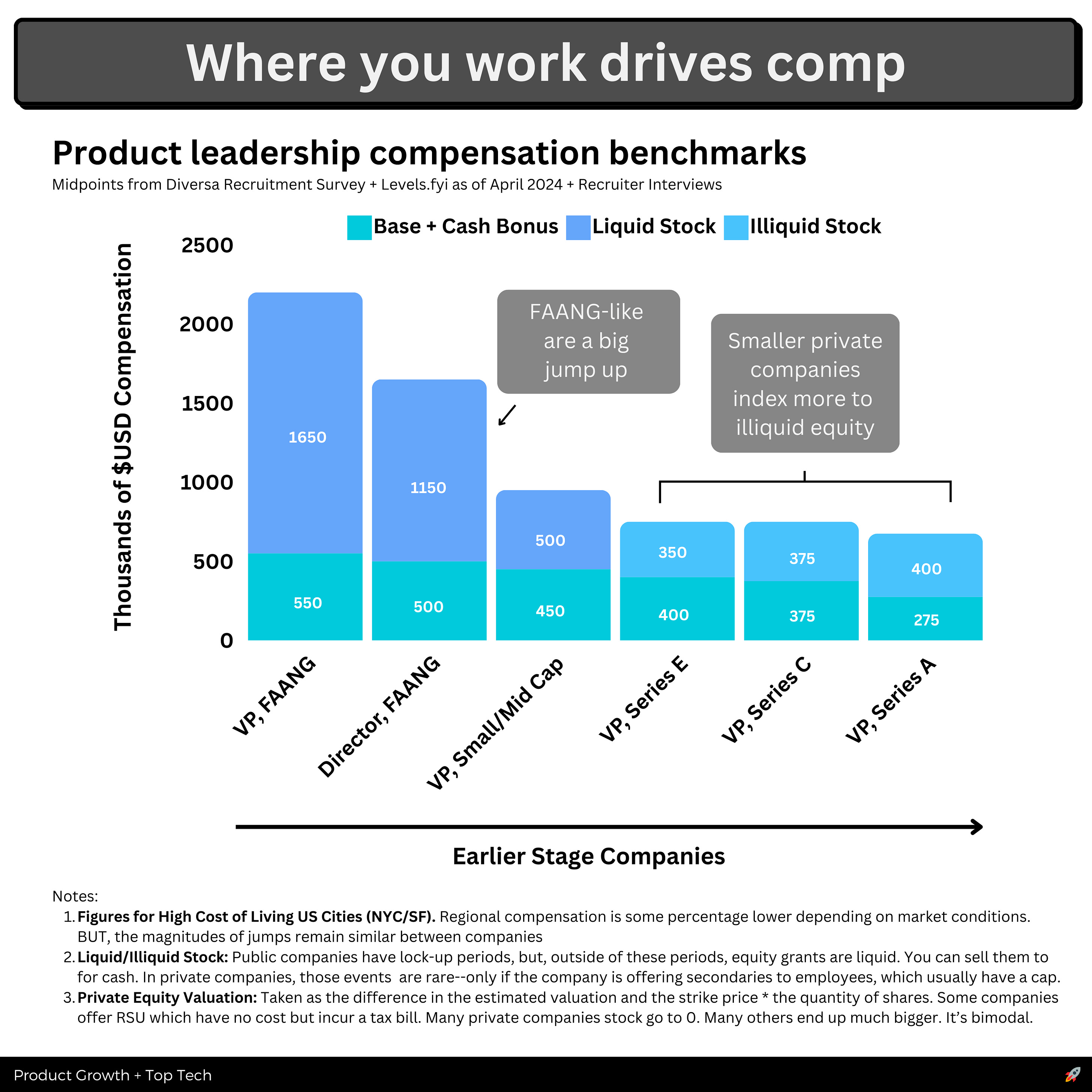
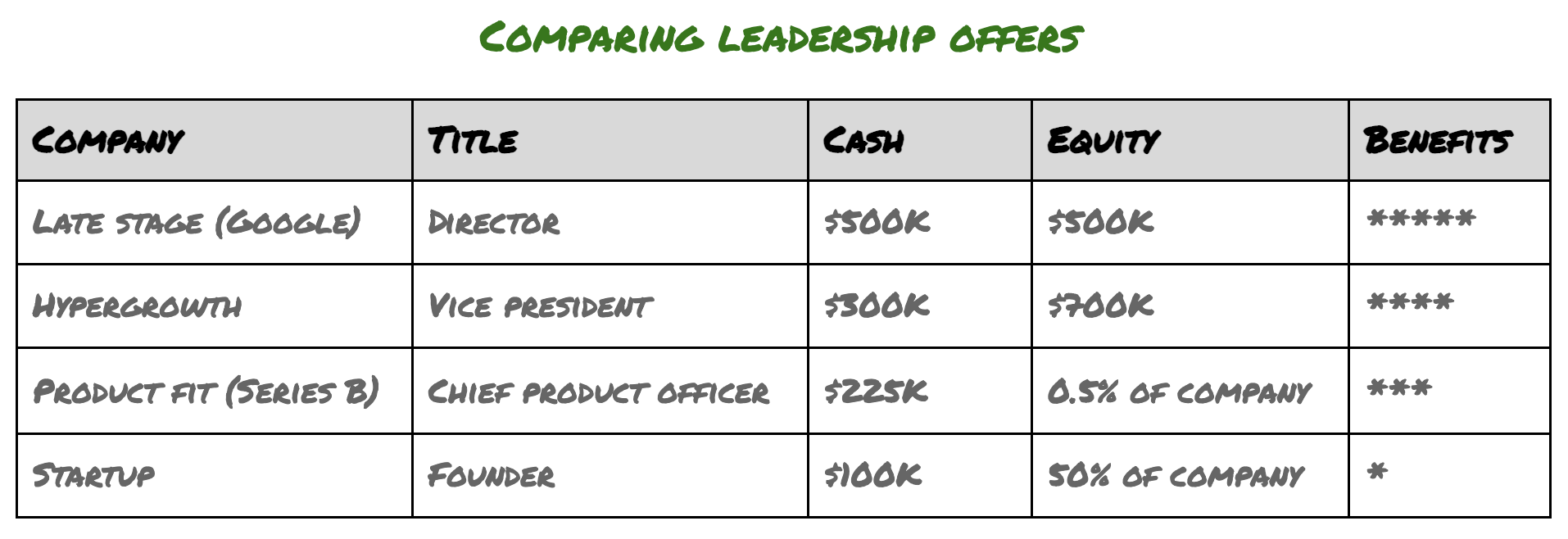
Colin writes the Top Tech newsletter, coaches product leaders seeking or negotiating job offers, and has experience from both sides of the product leadership job search. Warning: This Might Make You MoneyThere’s a huge range of pay disparity amongst product leadership roles. Two rules govern these disparities. First, the stage/revenue of the company determines your range:
If you’re not venture-backed, you can also roughly align these as: series A to $10M revenue, series C $10M, series E $500M, small/mid cap $1B, FAANG $100B. Second, the success of your company has a huge impact. For instance:
That’s a TC difference of about 2x, or $475K per year. Between those two rules, if you are able to move to a higher stage company or a more successful company, it will mean millions of dollars over the course of your career. Today’s PostWords: 21,600 | Est. Reading Time: 98 mins We’ve talked to 7 external Executive Recruiters, 2 internal big tech Executive Recruiters, 2 VC talent teams, and 12 CPOs/ VPs about the product leadership job search. Here’s what we’ve found:
1. How product leader (Director to CPO) searches are different1.1 The (Actually) Hidden Job Market for Product Leaders
At the Director level and above, the game changes entirely.
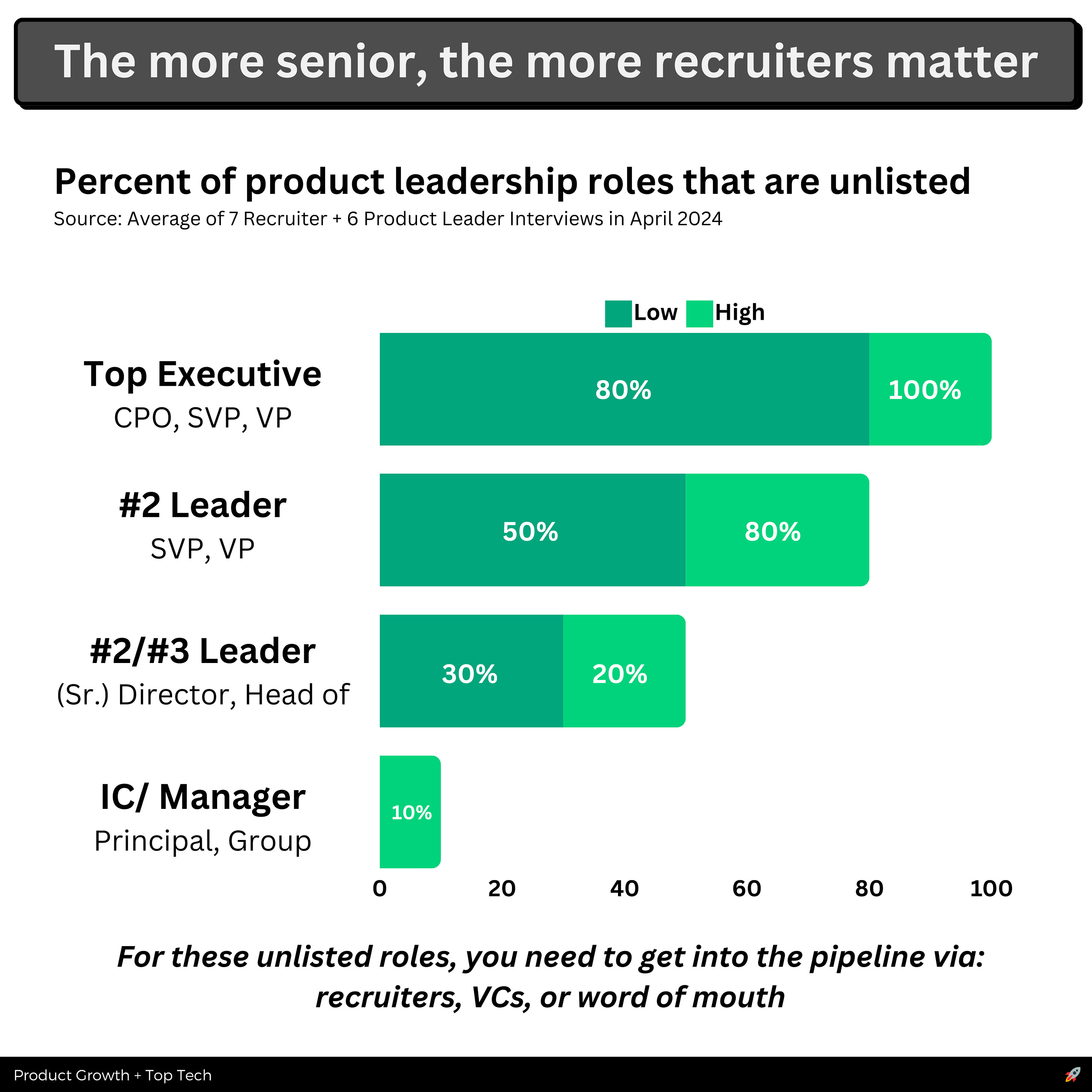
And here’s the thing: many of these top-tier roles never see the light of day on public job boards. They're stealth missions. Companies often kick off these searches before they have a finalized job description. Companies post these roles much less often for a variety of reasons:
This is where your executive recruiter and VC connections become your secret weapon. They know about these under-the-radar opportunities long before the rest of us catch a whiff.
1.2 The Critical Role of Executive Recruiters and VCs for Leadership Roles
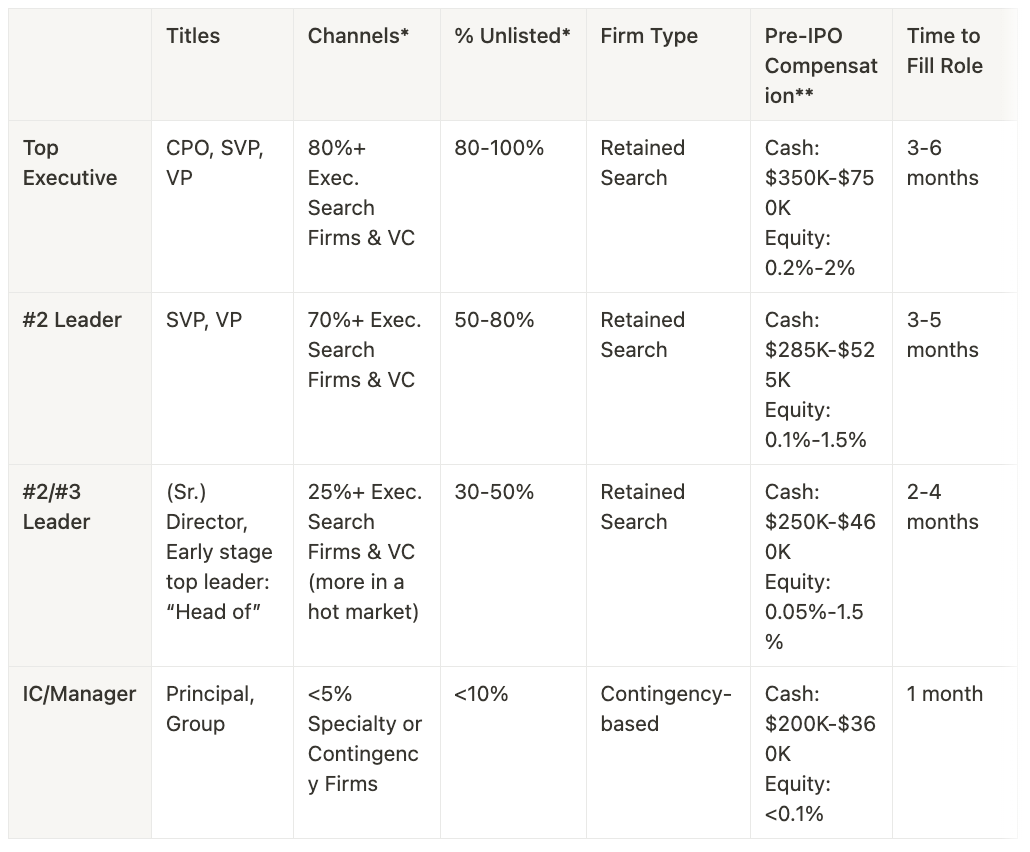
It’s not like your prior job searchesContrast this leadership job market with the landscape for individual contributors (ICs). Sure, there are exceptions where ICs look more like leadership searches - roles requiring extremely niche skills or deep industry expertise. But by and large, most IC positions will eventually find their way onto the usual job posting sites. Recruiters can still add value here, but they're more of a bonus than a necessity. For leadership roles, though? Ignore them at your peril. (And if you’ve had poor encounters with recruiting firms in the past? It is probably because they were contingency-based firms trying to compete to fill a role, and not the retainer-based executive search firms.) How the job search changes as you rise up the leadership ranks
Sources:
But you can’t sit backBut here's the thing - you can't just sit back and wait for them to come knocking. Not even if you're a bona fide rockstar in your field. Some inbound interest may trickle in, sure. But the real magic happens when you take the reins and proactively cultivate these relationships. That’s what we’ll cover in today’s piece. When executive recruiters and VC firms are involvedSo when do companies enlist the services of recruiters and tap into their VC networks to fill a role? There are 5 main situations where external help is needed:
Often, only external executive recruiters can give high-priority searches the white-glove treatment they require.
1.3 How Product Leaders are Evaluated DifferentlyThree main criteria are used:
But First, A Warning: The Criteria Will EvolveA lot changes during the 2-7 month search process for a product leader. In the first few weeks, employers will speak with many candidates as they are still figuring out exactly what they want and need from a role. They have only conducted these searches every 2-4 years, if ever. So, they do not have a great first frame of reference for what they need until they see a variety of candidates. This means you need to have patience in your search and are likely to speak with companies who do not yet have their criteria solidified. It is very common for companies to start with very strict criteria: i.e. “We only consider candidates from top companies at our stage or higher, in our market, at this exact seniority level, who have done exactly what we need before successfully.” But that often slowly shifts to tangential markets, up and coming candidates doing a level jump, and candidates who had a large impact at lesser known companies. Some criteria is also very company, role, and hiring manager specific:
You will need to leverage your recruiter or company contact to understand what they are looking for, how to interpret that, and how you fit their criteria.
Criteria 1: Reputation
The consensus among the executive recruiters and hiring managers we spoke with is that your reputation is one of the most important criteria for landing a role. There are a few important signals for reputation:
But even more importantly…
This validation from a trusted third party is necessary because:
This has 3 important implications for your job search: 1. Intros matterBecause reputation is arguably more important than on-paper results at leadership levels, cold outreach is less effective than at IC levels**.** If you want to get connected with a hiring manager, an executive recruiter, or any decision maker at a company, you will first want to get a warm introduction from someone who can speak highly of you. Past managers or executives, past colleagues, mentors, or even executive recruiters you have worked with in the past can all be potential connectors. Colin has coached product leaders who were successful at cold outreach, but generally an introduction is going to be necessary. 2. Backchannels are always done
None of the Executive Recruiters or executives we spoke with have hired someone without running a backchannel reference. This means that at some point in the process, they are contacting your past manager, executives, or colleagues through someone in their network. 3. Tenure mattersAccording to Andrew Abramson — a 10 year executive recruiting veteran and ex-Partner at Riviera who founded Fusion Talent — leaving jobs too soon and creating a track record of job-hopping is the "single biggest thing killing a career’s momentum." It creates a "perception by hiring managers that they won't stick around." Andrew advises that "a good stint is 3 years if no exit outside your control" and cautions against "back to back 1 year stints." If you are coming off a short stint, "don't just take the next job" - do deep referencing on that company/culture to ensure you'll be set up for success. Andrew also suggests going to high quality companies and warns against taking risky roles at early stage startups just to gain more scope. Even if you are CPO and do a good job, "You could find yourself looking again in a year due to factors that are completely outside of your control.” Fair or not, this will stop many future employers from considering you if it is a repeated pattern. Criteria 2: Outcomes & Impact
At the Director level and above, it is no longer enough to launch features, discuss how you did it, and talk about the product metrics you impacted. You will need to start demonstrating significant tangible business impact from your work. That means increasing revenue, north star metric improvements, and strategically important outcomes. It can also mean helping a company get to a successful IPO or acquisition, or even scaling a team 10x (though beware to whom you are talking about that—for a certain political class in Silicon Valley, org building is the now enemy). Outcome Facet 1 - Company successOne signal of your impact and outcomes is having a long stint at a high growth successful company. That doesn’t mean you had to be CPO, but if you were accomplished and promoted frequently at a top tier company that was doing well, this will signal that you can make an impact that matters. One mistake leaders make is optimizing for scope over quality of company, especially if you don't already have a great company on your resume. Founders look first at the best companies a candidate has worked at that had high growth. Even joining at the highest level at an earlier stage startup can prevent you from gaining this reputation for being a winner. “Winners win.” is a quote recruiters often hear from founders. They assume that someone at a successful company during its growth phase will continue to win. Outcome Facet 2 - Your measurable impactIt should be obvious by this point in your career that you need to show demonstrated, measurable impact in your narrative and resume. What changes at the leadership level is the scope and level of that impact. Meaningful impact is typically a significant improvement in revenue, profit, or users. It can also be a significant strategic win. This is tied to tenure at a company. It typically takes several years to have a meaningful impact on a company’s business trajectory. Criteria 3: Domain ExpertiseMultiple Executive Recruiters we interviewed mentioned how important domain expertise was to hiring managers for product leaders. When they develop the “ideal candidate profile” (ICP) with the client, they often have a specific domain, team size managed, specific stage, and similar challenges faced. They want to know that you faced similar challenges and built the necessary processes and infrastructure in a similar context. This is unsurprising psychology by employers. They want to de-risk the hire as much as possible, and the best way to do this is by hiring someone who has “been there and done that.” If you do not perfectly match the ICP, you will need to show how your experience is analogous or tangential at least. For All Criteria: Career trajectoryA heavily used heuristic for both a reputable and outcome-oriented candidate is whether they have a fast trajectory of getting promoted and increasing their scope. A benchmark pace for promotions is every 12-18 months for top candidates. At least they should be increasing their scope and impact if not their level. The opposite is true, too. If a candidate is stuck at the same level for several years, they could be screened out before anyone talks to them. There is a paradox for leveling for leaders. The same recruiters and hiring managers will say both:
Ken Sandy, who has been a Director+ since the 90s and helps CPOs build teams, says that “titles do matter”. If you go to VP or CPO at a reasonably mature company, “once you’re in, you’re in.”
1.4 How Product Leaders are Compensated DifferentlyBig jumpsThere are increasingly big jumps in compensation as you move into leadership and up the leadership seniority ladder.
Highly variableThe variability in compensation is also much wider as you increase in seniority. Colin once received a growth-stage Director offer for $450K and another for $850K in the same week. Data sources changeFinding accurate and reliable compensation data at the leadership levels is also a mystery to new leaders. Other than a few Director roles at FAANG+, you are unlikely to get many data points from the typical sources like Levels.fyi or Blind that you used as an IC. Instead, you will want to use your Executive Recruiters, VCs, and fellow executives to find both the survey and anecdotal research you need. So how much do they make?Many of you will be familiar with Nikhyl Singhal — he is a VP at Meta, ex-CPO at Credit Karma, and coach to 100+ product leaders over his career. He provided this chart in 2021 as a rule of tumb for “elite” (meaning top of market) leadership candidates in tier 1 US tech cities and companies. He claims that this was consistent for several years, with some years (like 2021/early 2022) going above and other years tracking slightly below. 2023 was a tougher year, but this has started to return. If we compare that to the top 25% of offers in 2024’s Riviera Partners Compensation Report, we actually see higher numbers this year:
The VC survey data aligns closely with this. Note that anecdotally we have heard from recent Directors who landed roles coming in at lower TC for growth-stage companies. This was mostly due to lower equity grants. Recent data from equity management platform Carta has shown the same, but this is starting to increase again. VPs at Meta or Google can make $4m+, while tier 1 big tech company CPOs can make into the $X0M range. Chris Cox, CPO at Meta, made $23M last year, with $18.5M in stock awards. How power dynamics changeAnother major difference in the job search for product leaders is the amount of power an employer has vs. you. If you are a serious candidate, you are not only allowed to reverse interview and vet the company just like they are assessing your fit for them, you are often expected to do this. Not doing so can be treated as a red flag. If you are a serious candidate, you are not only allowed to reverse interview and vet the company just like they are assessing your fit for them, you are often expected to do this. Not doing so can be treated as a red flag. 1.5 Product Leadership Hiring TrendsThe Executive Recruiters and Product Executives we spoke with shared some trends they are seeing in the job market today and how product leaders should adapt. Trend 1 - There are more great candidates than jobs.
What should you do? Keep your chin up. And, keep your pipeline full, even if you have amazing final rounds. Trend 2 - More companies are looking for “hands-on VPs”What should you do? Don’t downplay your scale, but check with the recruiter about which profile the company wants and tune your narrative accordingly Trend 3 - Companies are hiring fewer Director-level roles despite many new Directors promoted during ZIRPWhat should you do? Advice from an experienced product leader: If you are a new (<2yr) Director and did not have enough time to make a big impact in your first role, it may make sense to get a Principal or Group PM level role to create an impact in today’s market. There is no shame in being a builder again. Play the long game. Trend 4 - There are more “General Manager” (GM)-style Product leader roles
What should you do?
Trend 5 - There are more and new resources to leverage in your search
What should you do?
…But how can executive recruiters and VCs help me?Now that you know how the leadership search is different, you need to understand how to leverage the new players in the game. 2. How Recruiting Firms and VC Talent Teams Actually Work
It's a common experience - you're talking to multiple people at the same recruiting firm or VC talent arm, but it feels like each conversation is starting from square one. They seem to have no CRM, different roles, different information, and different priorities. So what's really going on behind the scenes? We interviewed people at top recruiting firms and VC HR arms to get the inside scoop on how they operate, and what it means for you as a product leader. ... Keep reading with a 7-day free trialSubscribe to Product Growth to keep reading this post and get 7 days of free access to the full post archives. A subscription gets you:
|





This week’s system design refresher: Top 9 Most Popular API Protocols (Youtube video) What is a deadlock? What’s the difference between Session-based authentication and JWTs? Top 6 ElasticSearch Use Cases Top 9 Cases Behind 100% CPU Usage SPONSOR US ͏ ͏ ͏ ͏ ͏ ͏ ͏ ͏ ͏ ͏ ͏ ͏ ͏ ͏ ͏ ͏ ͏ ͏ ͏ ͏ ͏ ͏ ͏ ͏ ͏ ͏ ͏ ͏ ...
Comments
Post a Comment