Ultimate Guide: Consumer Software PricingHow to supercharge your growth by evolving your pricing model
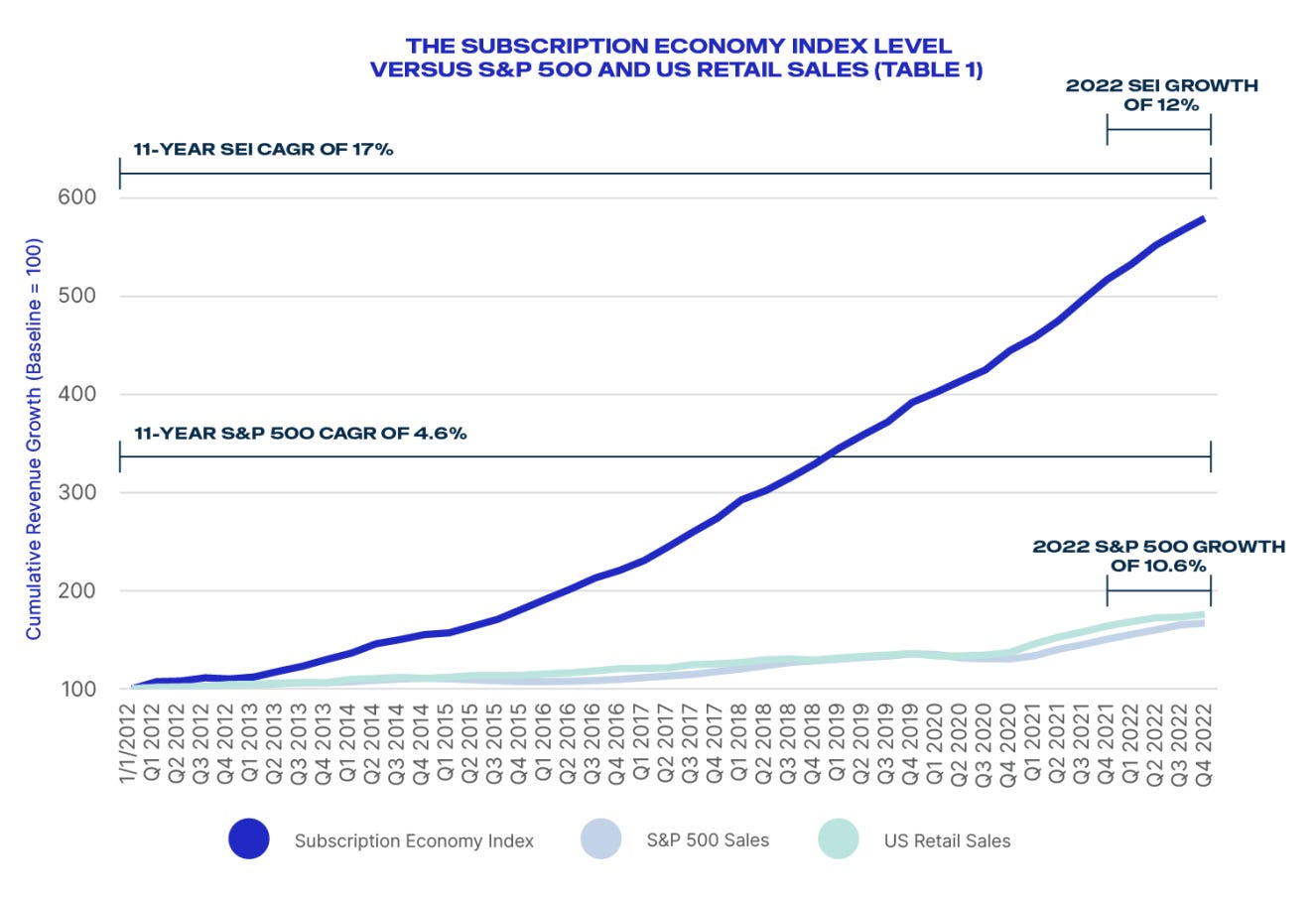
If you know anything about consumer software pricing, you know the subscription has risen rapidly. And, for good reason. The market cap of subscription companies is fast outpacing their counterparts:
Over the past 11 years, subscription-based companies have grown 3.7x faster than companies in the S&P 500. But when did the consumer software subscription start, and who uses it? And what drives this advantage? The History of Consumer Software SubscriptionsThere’s been 6 distinct chapters of the consumer software subscription economy’s growth: 1. Early Adopters (1980s - 1990s)Antivirus programs like Norton and McAffee were the early adopters of the consumer software subscription. They bucked the trend of perpetual licenses, taking their cue from magazines, cable TV, and insurance companies. 2. Annual Upgrade Plans (1990s)Software like Quicken, Macromedia Director and Grolier’s Multimedia Encyclopedia offered optional subscriptions, although the primary model for accessing the software was a perpetual license. 3. Subscription Video Arrives (Late 1990s)In 1997, Netflix launched its consumer video subscription, which was the first purpose-built subscription outside of Antivirus software to gain widespread adoption. 4. Everyone Joins In (2000s)Inspired by the B2B SaaS revolution of the early 2000s, consumer software began going subscription. Flickr launched with subscriptions in 2004. Then, Amazon Prime launched in 2005, and Skype also introduced a subscription. In 2008, Evernote, Dropbox, and Spotify all launched with subscriptions, as well. 5. Steady Diversification (Late 2000s - Early 2010s)The launch of the Apple App Store (2008) and Google Play Store (2011) ushered in the era of mobile subscriptions apps. Popular products like VSCO and Peloton took off in this period. Subscription products like Birchbox and Dollar Shave Club also took off in this period. 6. Explosion of Subscriptions (Late 2010s - Present)Now, we live in a consumer software subscription world. Adobe Creative Cloud (2015) and Microsoft Office (2017) switched over to subscription plans in 2011. Soon, players in every industry, from Duolingo to Substack (2017) joined. It’s really taken off over the last decade. In the United States, consumer’s now on average have 4x the subscriptions they had in 2014. A Forbes report highlights that in the first half of 2014, there were only 7.9 million paid music streaming subscribers in the US, compared to a staggering 90 million in 2024. It can seem like everything is trending towards a subscription. What is driving the shift to subscriptions?The challenge in most great businesses (eg, public one’s) isn’t continuing the franchise of a great product like Microsoft Excel or Adobe Photoshop. It’s getting your loyal users to keep paying you for it. That’s where subscriptions come in. CFOs love them for 3 reasons:
But it's not just on the business side. Consumer acceptance is on the rise. Continuous delivery from product teams—delivered seamless via the internet or app stores in your sleep—has justified the continuous cost. But subscription is hardly the only game in town for consumer softwareSome of the most successful products I’ve worked on have entirely different pricing models:
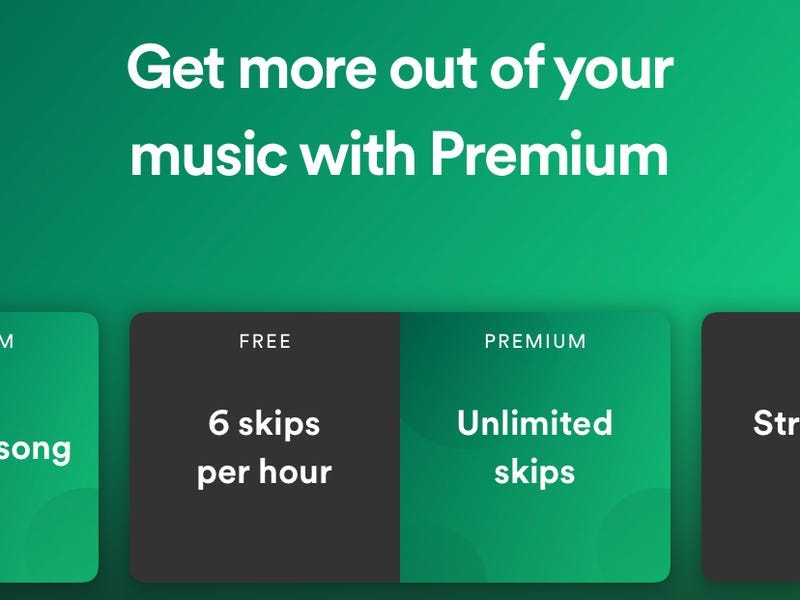
There’s so much more to pricing that just slapping on a subscription. And even within subscriptions, there’s lots of room to optimize. The Spotify Example: Growth from SophisticationRemember the days of unlimited music skips on Spotify's free tier? It was a golden age for music lovers. But, for Spotify, there was less gold than they hoped. So in 2014, Spotify limited skips on the free tier to six per hour.
The headlines were:
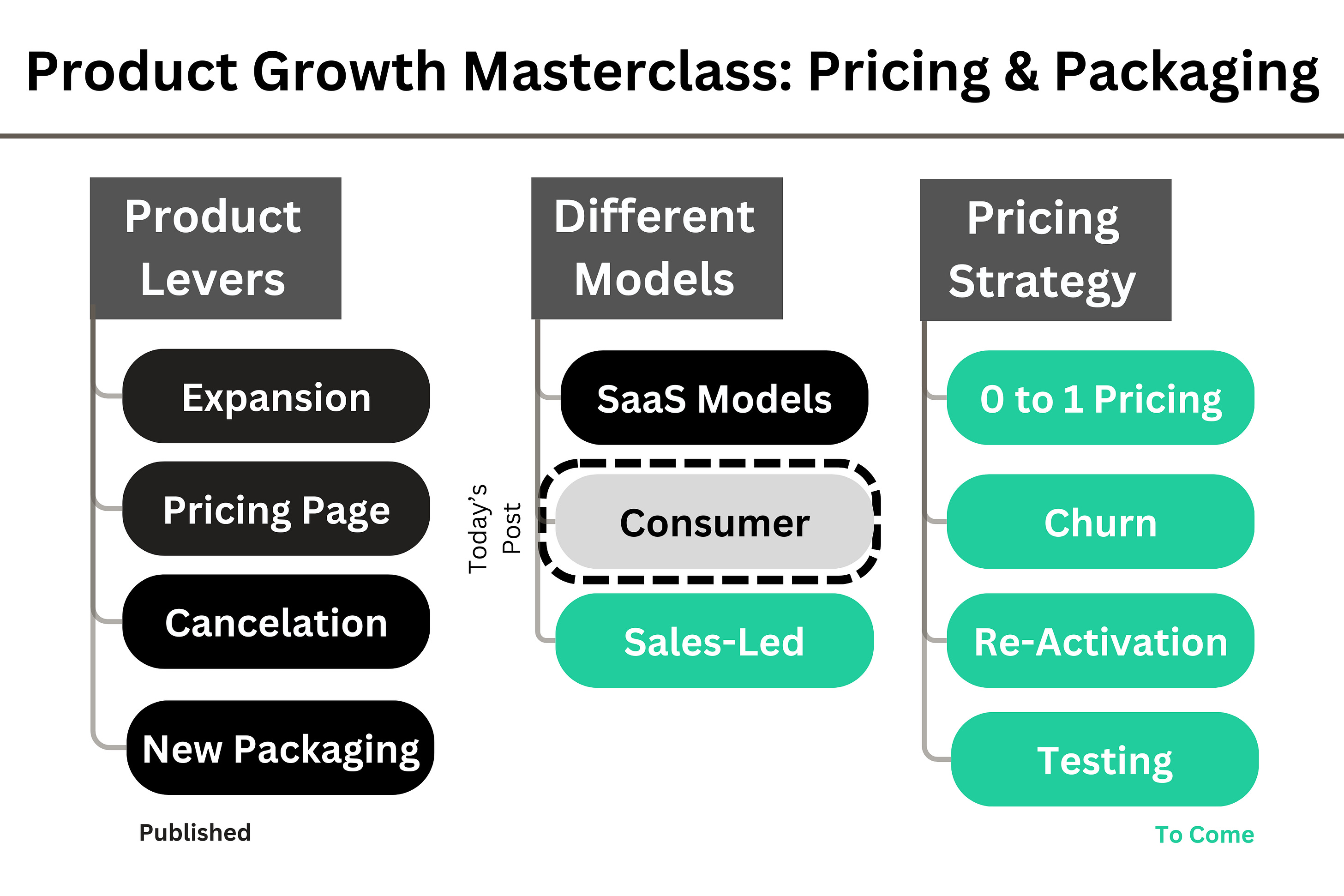
But 6 months later, Spotify had seen a 25% increase in paid subscribers—well above analyst expectations. And, the cherry on top? Churn rate among free users did not go up. How did they do it? The detail that is missing from 99% of commentary is: they implemented it as a reverse trial. Users experience unlimited skips for their first 7 days, but THEN hit the skip limit. That’s the power of iterating on your pricing—and getting sophisticated—as a consumer software company. It’s not just about adapting a subscription model. It’s about getting sophisticated with your model. Today’s Deep DiveI’m going to help you go beyond a 201 understanding of pricing and really go deep. Words: 5,345 | Est. Reading Time: 25 Minutes
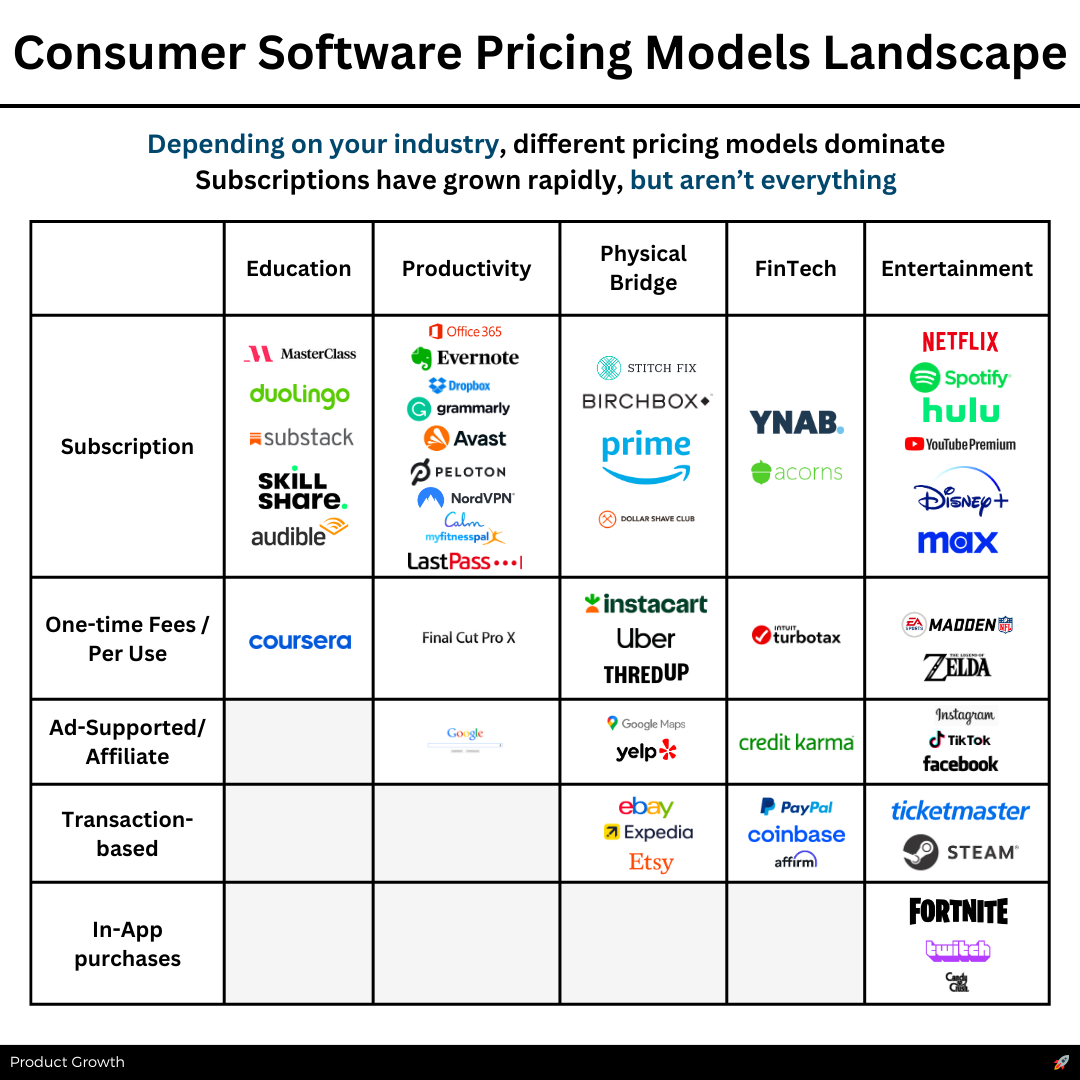
1. Taxonomy of consumer software pricing models and strategiesSo if subscription isn’t the only game in town, what else do big consumer software companies actually use? I analyzed 50+ of the top consumer software products out there. Let’s use this dataset to break it down. The industry you’re in dramatically impacts your options of pricing models:
No matter what industry of software you are in, subscription products have become dominant players. But their prevalence depends on industry—with education the least diverse and entertainment the most.
Most interestingly - even those that end up in buckets line one-time—eg, TurboTax—often force a recurring pattern with annual upgrade options. Subscription or “subscription-like” pricing is, in total, 56% of this list. 2. The key strategies that sit atop modelsAdjacent to the core model is: what are your pricing strategies? These sit atop the model itself. 5 major strategies are trending right now (from most to least common):
Let’s go through the data and why on each. ... Keep reading with a 7-day free trialSubscribe to Product Growth to keep reading this post and get 7 days of free access to the full post archives. A subscription gets you:
|





This week’s system design refresher: Top 9 Most Popular API Protocols (Youtube video) What is a deadlock? What’s the difference between Session-based authentication and JWTs? Top 6 ElasticSearch Use Cases Top 9 Cases Behind 100% CPU Usage SPONSOR US ͏ ͏ ͏ ͏ ͏ ͏ ͏ ͏ ͏ ͏ ͏ ͏ ͏ ͏ ͏ ͏ ͏ ͏ ͏ ͏ ͏ ͏ ͏ ͏ ͏ ͏ ͏ ͏ ...
Comments
Post a Comment