Product Pulse #3: What you can learn from PalworldPlus: PMs in non-tech companies, Whether Product Is Overrated, Product Growth Benchmarks, the Vision Pro, Google's 2 New 100M subscriptions, and Google's Corporate OKRs
👋 Hi, there. This is Aakash. Product Pulse is a new series covering the latest product and tech news relevant to builders. Have a source? Send me a message. In Today’s IssueWords: 2,677 | Est. Reading Time: 13 minutes
1. What you can learn from Palworld These are just a few of the insane stats that Palworld - “Pokemon with guns” - has racked up in 2 weeks after launch:
And it did all of this on a budget of $6.75M. By comparison, Bethesda’s Starfield had a budget of $400M and peaked at 30,000 concurrent players on Steam. The story is inspiring:
What lessons can product & growth leaders take from the game’s rise?
Let’s go through each. Lesson 1 - The Japanese ‘DNA Model’It’s tempting to think Palworld has no creativity or originality. But it’s actually a really cool example of the Japanese game development concept, the DNA Model. The DNA model is a cross: you take the gameplay from one genre, and you take the systems from another, and you just cross them. That’s what Palworld does. It takes the gameplay from Fortnite and the systems from Pokemon, and it puts them together. The mash-up is alive and well. Lesson 2 - It can be worth having fresh eyes to a market you don’t understandHere’s what CEO Takuro Mizobe said in his epic blog post (worth reading in full):
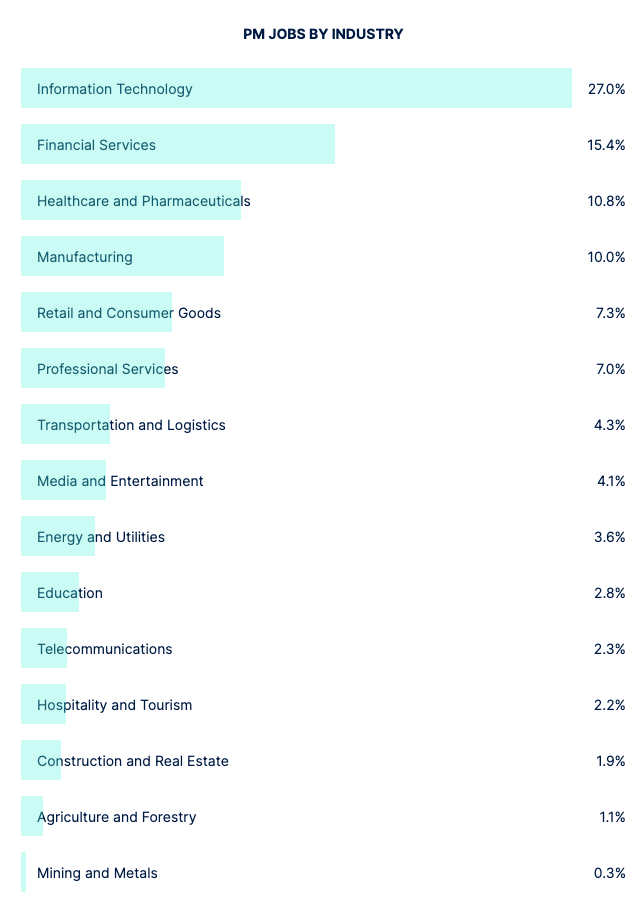
This is counter-intuitive for most. It’s tempting to hire people who are perfect fits background-wise for a role. But passion, dedication, and love for what you’re doing mean a lot. Lesson 3 - Platform for going viral + perfect execution = viral formulaSteam is a viral hit platform. Before Palworld, there was Among Us, Goose Goose Duck, Stardew Valley, and many more. Palworld took all the lessons from those perform them and executed on the template: a niche, with a couple developers, and less than $30. You need to study your platform and learn from the best. You may want to continue by taking this to your browser: 2. Most PMs are in non-tech companiesWith all the layoff news in the tech industry - much of which we have covered in the Product Pulse - it can seem like there are no open PM jobs. There are, they just aren’t in tech. Subscriber Salil Sethi shared interesting data from Prosper Circle on what industries the open PM jobs are actually in:
It’s crazy to see that long tail. Fully 73% of the open PM jobs are outside the tech industry. And the good news is: these industries are experiencing far less layoffs and job freezes. Instead, their PM orgs just continue to grow. Of course, the Prosper data set isn’t a full sample of jobs. So it would be interesting to get a sampling of Product Growth readers:
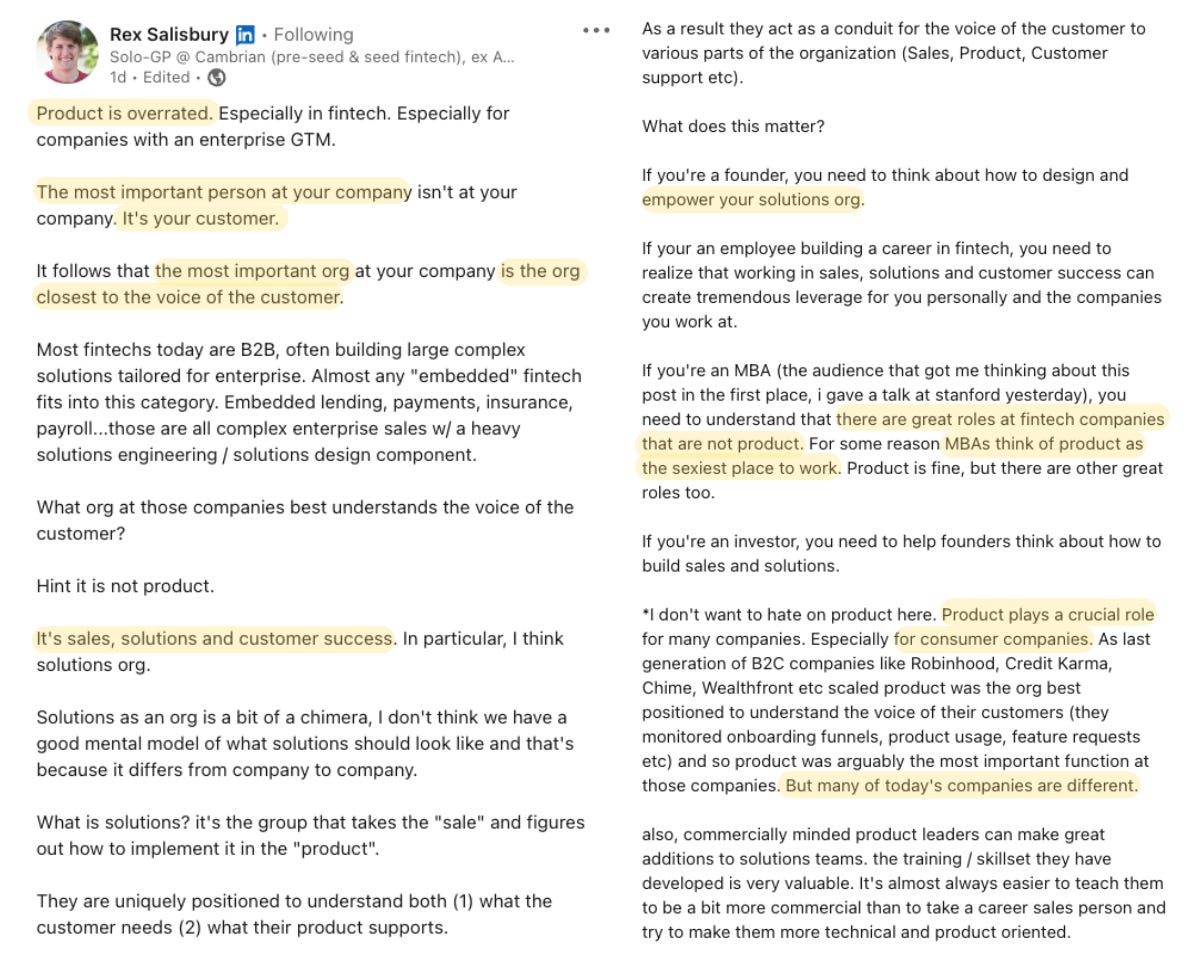
I’ll report back on the results next week. You can find templates to expense Product Growth here: 3. More Talk of Product Being OverratedRex Salisbury, former A16Z partner who is now a VC on his own at Cambrian, had a spicy take on why product is overrated:
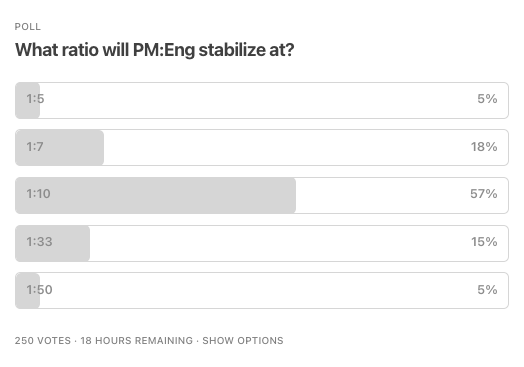
MBAs, as he points out, tend to think that product is the sexiest role to work in. But in enterprise fintech, solutions, sales, and customer success actually tend to be closest to the customer. The same can be said for enterprise software generally. Because the customer is the most important person, the org closest to it tends to be important. These are interesting points. The takeaways make sense for MBAs. But for your average PM, this is just a reminder to stay close to your customers. As it relates to the future of PM, it doesn’t really mean much. Even at enterprise fintechs - like Affirm, where I worked - you still need PMs to do the hard work of translating the voice of the customer into the product, alongside design and engineering. As a result, this seems like a less frontal attack than the one we discussed last week, when we talked about the ratio of Engineers:PMs potentially decreasing over time. I mainly include this topic in today’s newsletter to reflect back on that piece. In that piece, I asked you all what ratio of Engineers:PMs you think PM will settle on. You all tended to agree with me, with a 10:1 ratio of Engineers:PMs the dominant guess:
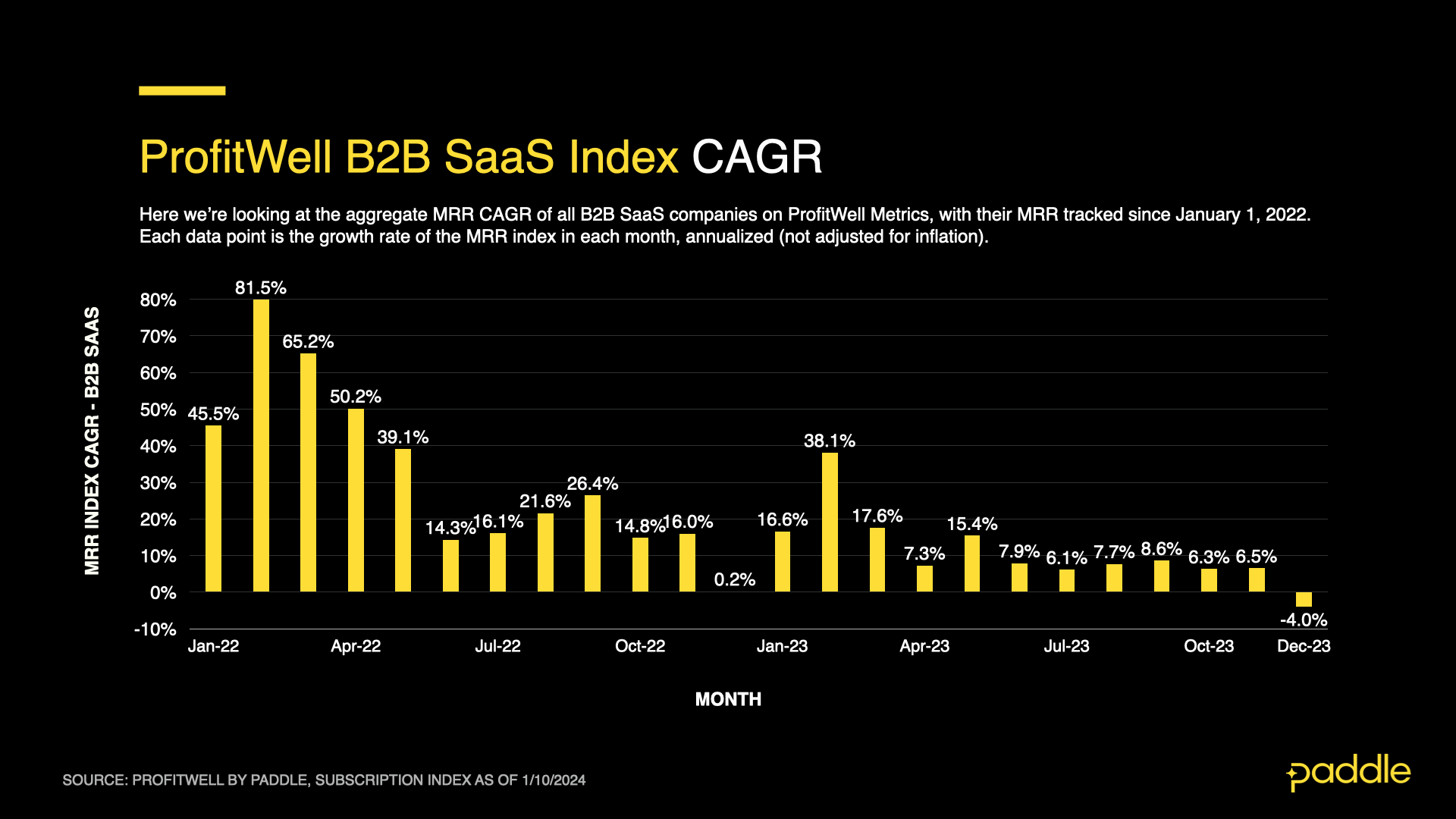
With everyone from Elon to Rex taking digs at PM, that prediction seems increasingly more likely. 4. Product growth benchmarksIt’s the traditional Monthly Business Review dance, “what drove our metrics?” As we know from the Fundamental Attribution Error, we often attribute these changes to ourselves, when it is really the situation. That’s where reports like Profitwell’s 2023 B2B SaaS Market Report come in handy. They have access to the data from more than 34,000 of Profitwell’s customers. So it’s a pretty comprehensive sample. Let’s take a look at 4 of the most interesting insights. Insight 1 - December 2023 was the first MRR decline on record for B2B SaaSB2B SaaS has had a good two years. But, more than likely, your growth stalled in December. The market’s didn’t just stall, it went down:
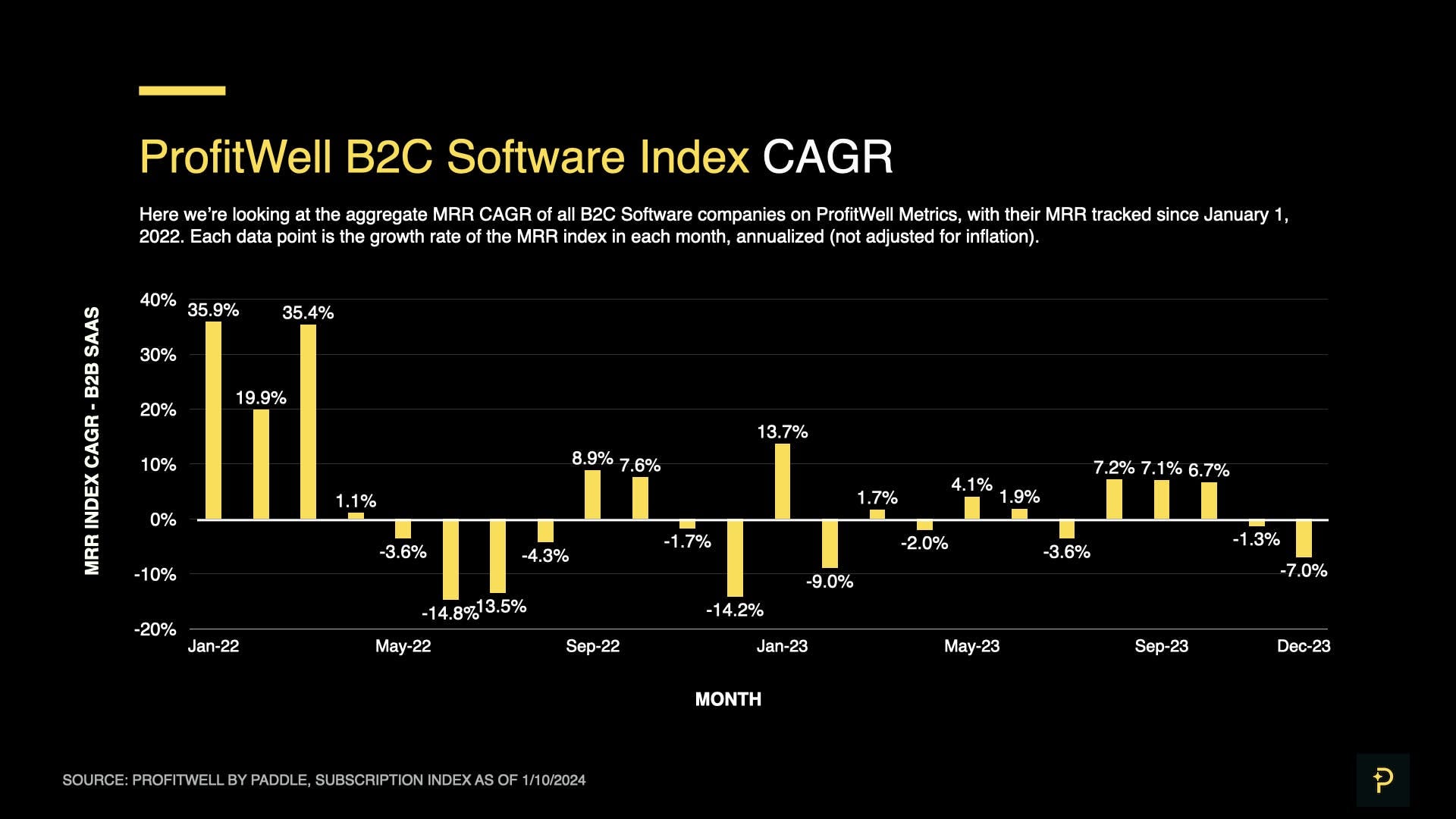
So, if you still had positive growth in December, good on you. Insight 2 - B2C also had a revenue decline, although it wasn’t the firstB2C software hasn’t had quite the steady growth of B2B, and December was no exception. MRR was down 7%:
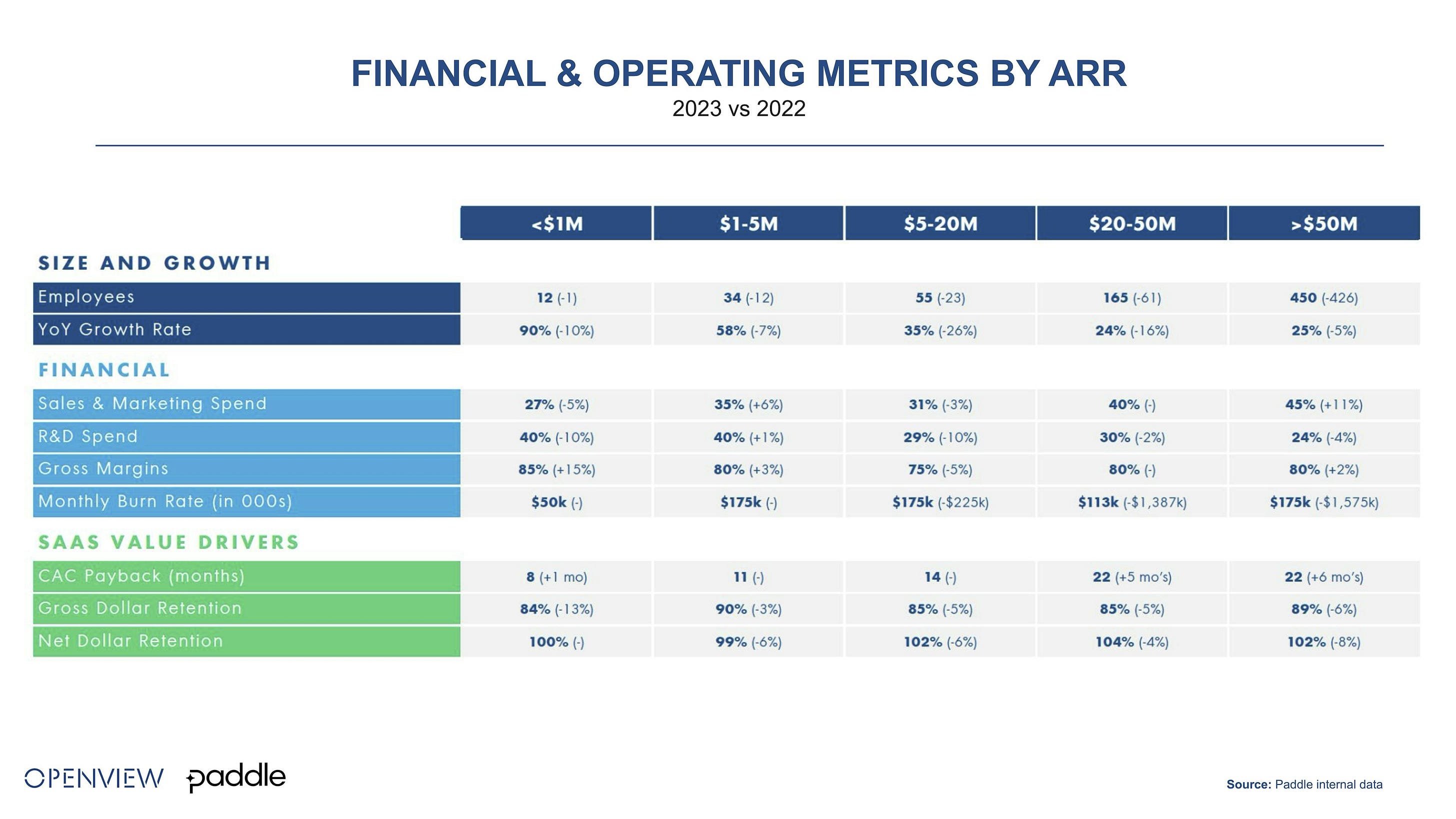
Insight 3 - Financials show a clear focus on reducing burnAcross the board, companies are working to reduce their burn:
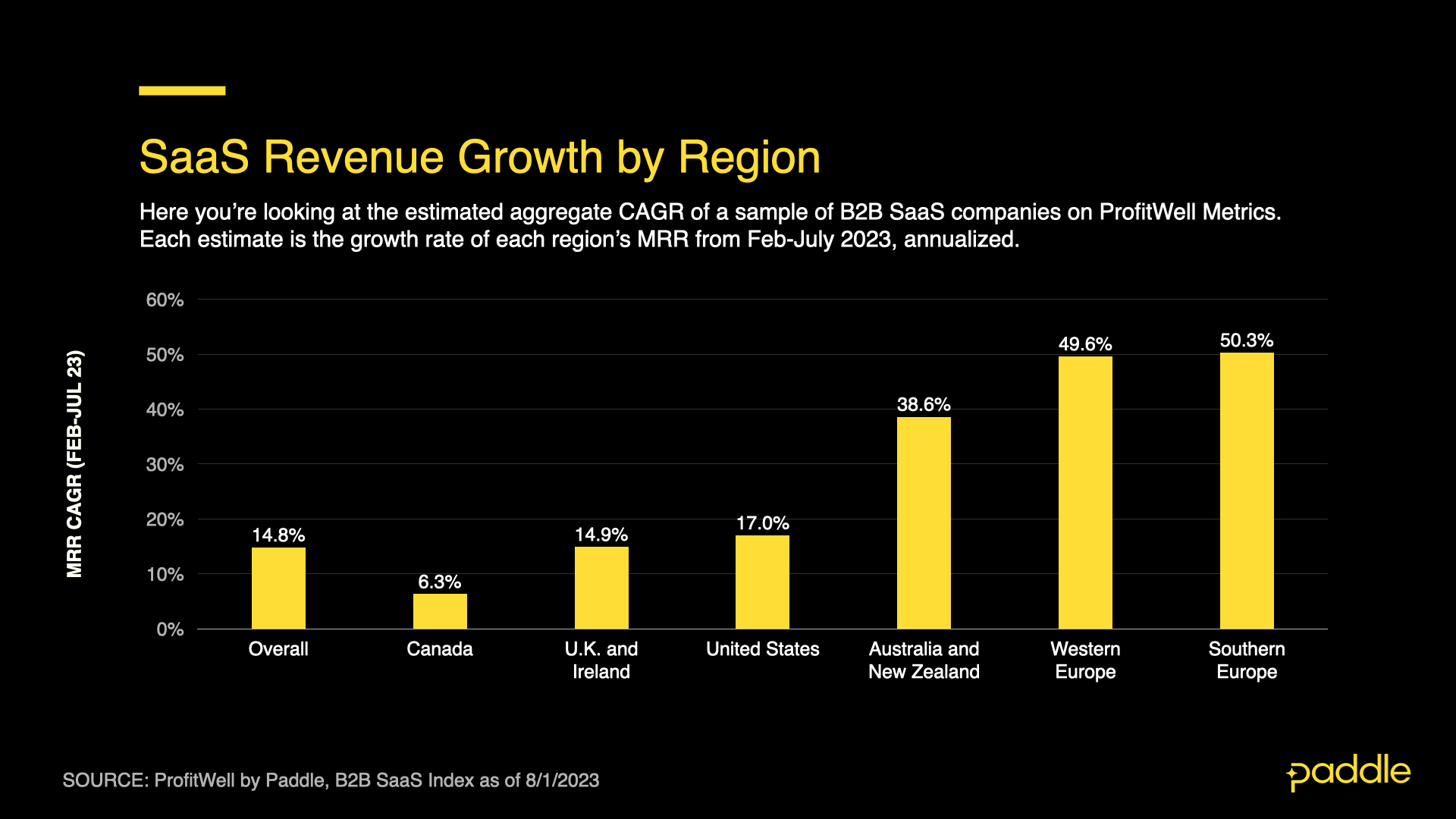
This has come, in large part, from reduction in R&D spend (including, often, layoffs). Insight 4 - Growth varies dramatically by region
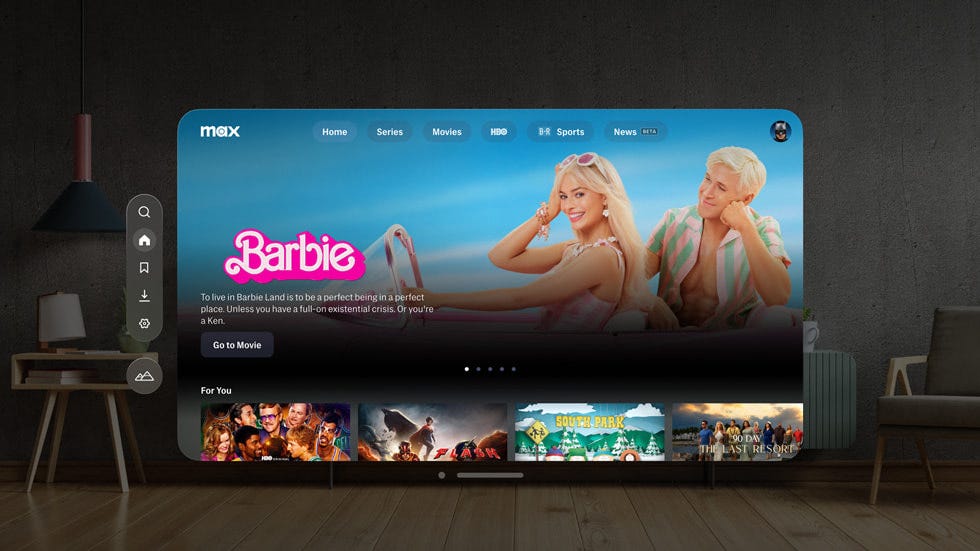
Some regions like Europe and Australia/New Zealand are growing much faster than the US and UK. These can be attractive targets for growth. There’s nothing hugely groundbreaking about these benchmarks, but I’ll keep sharing useful one’s as I come across them. 5. Should You Be Building for Vision Pro?Apple thinks the Vision Pro might be the computing platform of the future. Most of us are skeptical. But, given the company’s track record, it’s worth giving the platform a closer look:
What are the 600 apps on the marketplace at launch?
There are three major categories that make sense for the Vision Pro right now - video, gaming, and productivity - and you see representation from all of them:
How hard is it to make an app for the Vision Pro?It’s an entirely new skillset for your developers and designers. There’s a whole set of shaders and interface guidelines that you’ll likely need a technical designer to implement inside XCode, like how games are developed: As Marques Brownlee says:
You are going to need to hire VR designers and developers. Who probably should be building for the Vision Pro?Given how much work it is, it’s not clear anyone really needs to build for Vision Pro yet. Apple only produced 60K-80K units of the Vision Pro for this initial launch. And it only expects to sell 400K units in the first year. It reduced its own estimate from 1M. On the other hand, Apple sells over 200M iPhones a year. Even if you got 1% of Vision Pro users to pay you $60, that’d be $240K. About how much your technical designer would cost. So, to summarize, building for Vision Pro has high cost and low benefit. That’s why Netflix, YouTube, Spotify and others skipped making one. A “wait and see” approach is probably the best option to developing for the Vision Pro — unless you’re a huge productivity, video, or gaming app. 6. Google’s two new 100M subscriptionsThe big tech companies are quietly racking up new ways to get you to pay them monthly. Whether it’s Amazon Prime, Microsoft 365, or Apple One, they get you to pay. In Google’s case, two new products have hit the 100M mark:
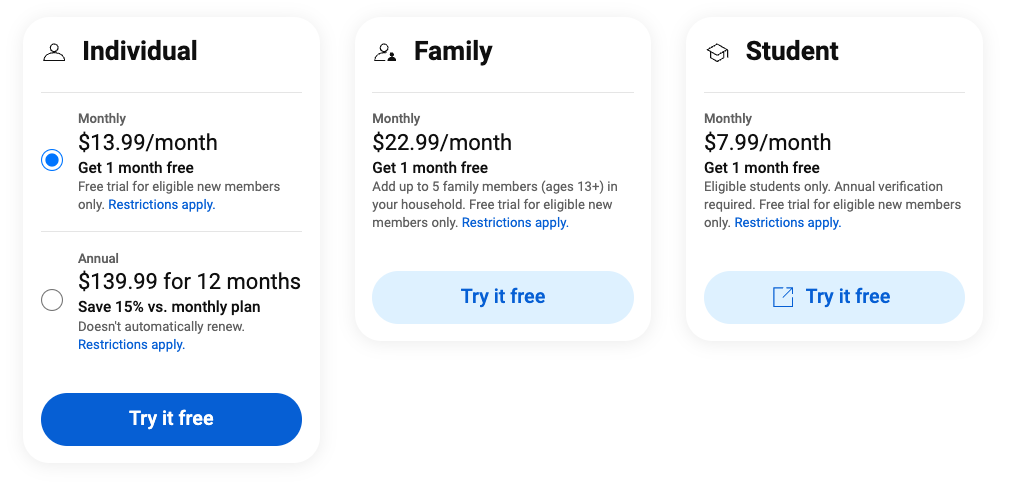
Clearly: the consumer subscription is alive and well. Let’s explore these two products in a bit more detail to appreciate what makes them so smart. YouTube Premium/ MusicYouTube Premium is a product that only Google can provide. It combines ad-free YouTube with the music catalog of Spotify. It’s a frontal attack on the two buzziest names in consumer subscriptions: What’s genius about this product is: there’s really no other competitor to YouTube’s mid-form content on the web right now. There’s short-form over at TikTok, and then there’s long-form over at Netflix. So YouTube brings massive value in its product, and this translates to its price:
This is ‘second cheapest’ pricing:
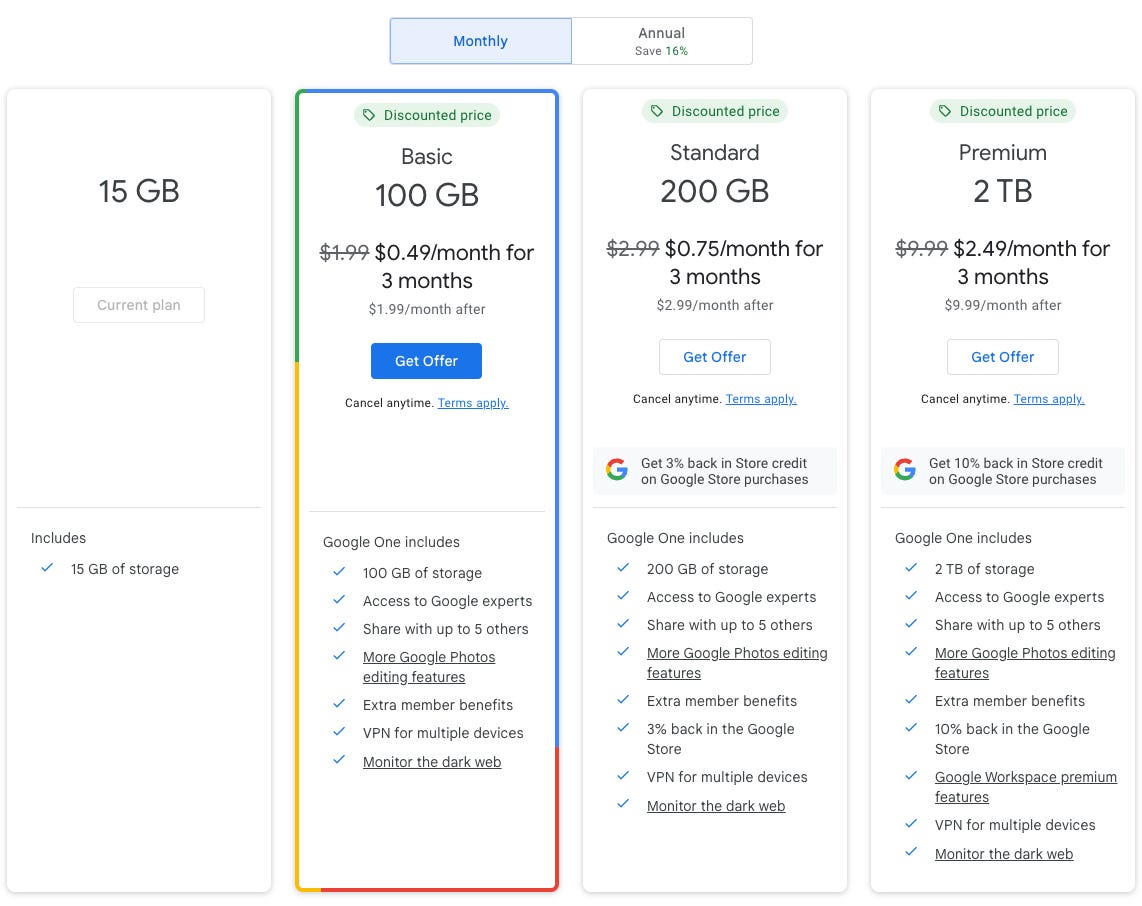
It’s more than Spotify, but not quite Prime or Netflix. And that’s attracting massive customer interest. Google OneGoogle One is the Google play to monetize several of Google’s biggest products, all in one bundle: Gmail, Gsuite, Google Photos, and VPN. It’s not nearly as costly as YouTube Premium/ Music:
Just like YouTube premium, it is ‘second cheapest’:
That doesn’t total to much. Let’s say the average plan is $2.99 per month. At 100M subscribers, that’s only a $3.5B business. Compared to Google Search Ads revenue of $173B, it’s a measurement error. It’s interesting to see how little Google has been able to monetize those massive (gmail, google docs, google photos, etc) products to consumers. The enterprise and ads play continue to be its dominant motions there. That also might explain why Google’s pace of innovation is so slow on the consumer side for these products. The teams probably just aren’t that big. Takeaways from Google’s SubscriptionsLike the rest of the big techs, Google has a strategic focus on its consumer subscriptions. It’s growing them well, but both have far more room to grow:
The Elephant in the RoomAnd we haven’t even talked about the final boss in the consumer subscription big tech cage fight: Apple. Across everything Apple provides, it has more than 1B subscribers. The most interesting one of these is Apple One. Apple One competes against both of Google’s subscriptions, with the bonus of Arcade:
At $19.95 it’s an interesting bundle. Given the momentum behind Premium and One, Google seems likely to keep them separate. 7. Google’s OKRsMy friend Alex Heath published Google’s Corporate Objectives:
Many people responded to these with a major yawn. It’s a reasonable response. They are vague and high-level. But Google takes its corporate OKRs seriously - Sundar Pichai chief among that crew. What was he thinking? Lesson 1 - Prioritization WinsFirst - it’s all about prioritization. What does Google put first? A market that it’s barely even monetized yet - not its massive search ads business - but AI. Google has 182,000 employees. To proclaim to that massive ship AI is what’s #1 is a big deal. Lesson 2 - Retention is All the Fuzzy ValuesSecond - Google has gotten many people to use its products. But it needs to keep them. Competitors are everywhere:
That’s why it focuses on so many fuzzy values like “most helpful,” “most trusted,” and “extraordinary.” These are the values Google needs to live up to, in order to retain users. Lesson 3 - Objectives’ Context Lives in the KRs and InitiativesEveryone has hilariously vague objectives. But these are actually usually paired with rolled up KRs across all the executives that roll up to Sundar. That’s why there’s almost a “completely exhaustive” structure to them. Lots of key results and initiatives across different business units live under each objective. Looking at objectives alone always looks wonky. The Latest Content CadencesJanuary was the newsletter’s lowest paid unsubscriptions month ever. We continue to smash through our North Star Metrics! Feel free to hit reply if you have other thoughts to reduce churn. In an effort to continue that, I’m coalescing on a cadence like this for the newsletter per month:
Product Pulse, specifically, was created to talk about tech news and more timely topics, in addition to the evergreen deep dives.
Up Next
We’ll see you then. P.S. You can earn free months of Product Growth by Recommending Friends: You're currently a free subscriber to Product Growth. For the full experience, upgrade your subscription.
|




This week’s system design refresher: Top 9 Most Popular API Protocols (Youtube video) What is a deadlock? What’s the difference between Session-based authentication and JWTs? Top 6 ElasticSearch Use Cases Top 9 Cases Behind 100% CPU Usage SPONSOR US ͏ ͏ ͏ ͏ ͏ ͏ ͏ ͏ ͏ ͏ ͏ ͏ ͏ ͏ ͏ ͏ ͏ ͏ ͏ ͏ ͏ ͏ ͏ ͏ ͏ ͏ ͏ ͏ ...
Comments
Post a Comment