Version 2 of the book is here!
The book now covers:
And it gives you an end-to-end framework to understand it all. It’s the culmination of everything we’ve been talking about the newsletter in the last year. It’s hard to compare computer screens to paper text. So—this is for all those paperback book lovers like myself. The Story of Version 2I’ll admit it: The reviews of version 1 weren’t up to my standard. As a writer, I hope to create content that resonates and delivers 10x the value. A 4.0 rating on Amazon isn’t that. When I look at other books with higher ratings, I know I can do better. And I don’t want to give up paperback books. I just love holding and reading books. In fact, I plan to write more of them. So, as I wrote in The Product Growth Story of Product Growth, I have been working on an update for The Ultimate Guide to Getting a PM Job the past several months. What I’ve really done is, I’ve followed the product process:
I think that results in a version 2 that’s 10x better, but I’ll let you all be the judge of that. This was my process. 1. Customer discovery on the key problemsSince the north star for version 2 of the book was improving my Amazon reviews, those were the primary source of data. On Amazon, there were 5 main categories of complaints:
Feedback 1 - Hastily put togetherThis was one of the harder one’s to hear:
There was obviously roughness around the edges in the construction of the book. I hadn’t paid enough attention to all the details. As I investigated with follow-up research, I found specifically:
Feedback 2 - Not enough getting a job contentThis was by far the most common piece of advice, showing up in all of the reviews:
This was honest feedback too. The second two parts of the book are some of my most banger content… But they aren’t directly relevant to the name and packaging of the book. I learned a crucial lesson: For books, your name is everything. I probably should have known this. The same is true of newsletter and social media posts. But I just missed the boat on the packaging in version 1. Feedback 3 - Doesn’t have enough interview adviceIn particular, one reviewer specified the exact content I was missing:
Looking back at version 1, I see it. There are so many different types of intimidating PM interview question types out there. But just 5% of the book talked about them. It needed to be more like 50%. Feedback 4 - Not enough depth and practical strategiesI thought the content I did have was solid. But one reviewer disagreed:
While it hurt to read, on reflection, I figured out how I could make the depth and practical strategies much higher. By:
So, I validated this feedback area, as well. Feedback 5 - Links to templates that were hard to accessThe final area of feedback in the reviews was on the templates:
On investigation, I totally missed the packaging of the templates. I needed to make them very easy to visit URLs that anyone could go to. That was a miss. Summary of the Review DiscoveryBased on the reviews, I had a good sense of the major problems. When I investigated each problem, I more or less agreed with the criticism. It reminded me a lot of my PM days on software products. The criticism is usually right. The next step was to think through “the first principles why” of these problems. What happened? I had basically chosen the wrong name for the book. It’s information wasn’t all relevant to getting a job. I wanted to include some fun things like History of PM, but since books are expensive, those were an unnecessary luxury. This was the root cause of the problem. Qualitative ChatsWith a strong hypothesis on the overall problem, the next steps in discovery were for me to: a. Have 1-hour chats with 3 friends who read the book b. Ask feedback from 5 friends who read the book These chats with others confirmed my initial findings. One of my great advisors summarize the feedback thusly:
It resonated with me. Since my qualitative chats all were confirming those same 5 problems, I shifted a lot of chats to solution discovery. This helped me sketch out some plans for what to improve. Which is the subject of Section 2. 2. Dedicated time to rebuild key parts of the productI realized I needed dedicated effort to:
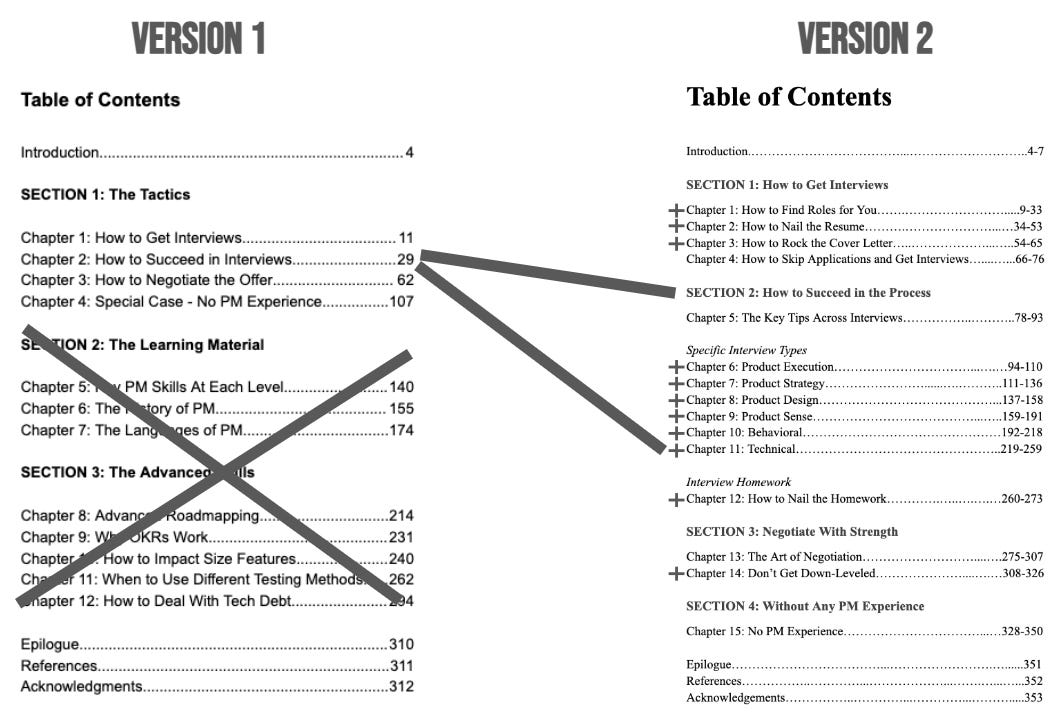
My qualitative chats with people were confirming this solution direction. At this point, I felt pretty good about my problem and solution discovery. Creating a RoadmapSo, I worked on the Table of Contents. What would a new structure for the book look like? See for yourself:
I got rid of sections 2 and 3, and really focused the book on a holistic process. This new roadmap accomodated all the feedback. And it became my new north star. Executing on the RoadmapOver the last 6 months, I worked with 10+ people on each of the chapters of the new book:
I didn’t just want to give advice. I wanted to give market tested advice specifically for PMs to show depth and specific insights. Getting the Details RightIn my plan for addressing all Feedback areas 1-5, a lot of it comes down to details:
I needed to get all the details, like template links right. So I have paid extra care to that. 3. Iteration of the content to create a finessed versionI released the initial content for each chapter as newsletter issues. This allowed me to get even further feedback on the concepts before adding them to the book. I then created book chapters that were iterated upon:
So this has allowed me to create a truly tight and finessed version. QAIn the first version of the book, I only had 1 editor: myself. And it’s hard to edit your own writing. For this second version, I’ve taken one additional step to finesse. I got an editor. And I asked some family members to read it. They pointed out things I missed. So, this should make for a much cleaner, less seemingly hastily put together, product. It’s just like software product QA: I did it more thoroughly, with more people. Small Details of EditsHere are a few of the smaller details that I’ve edited in this added finessing phase:
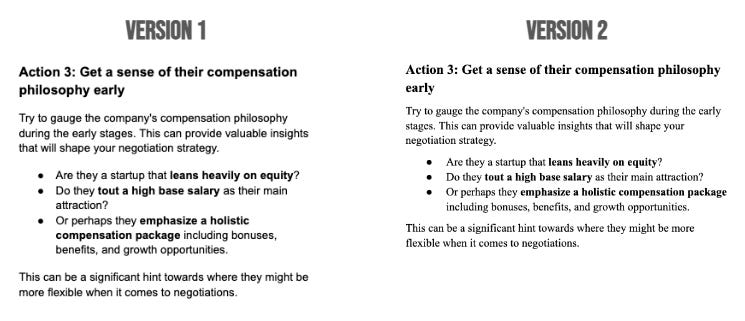
Small Detail 1 - New FontI love Sans Serif fonts like Arial on screens. They seem more modern. They have a cleanliness about them that works well on digital devices. But they’re not as great on paper. One quirk of the Amazon publishing program is you get the first copy of the book when customers do. So when I got the first copy of the book, I realized that the Arial just isn’t as authoritative on paper. On paper, the Serif fonts like Times Now Roman look more appropriate. It’s perhaps because Times New Roman was created nearly 100 years ago. It fits the medium of paper better. So I made the change from Arial to Times New Roman.
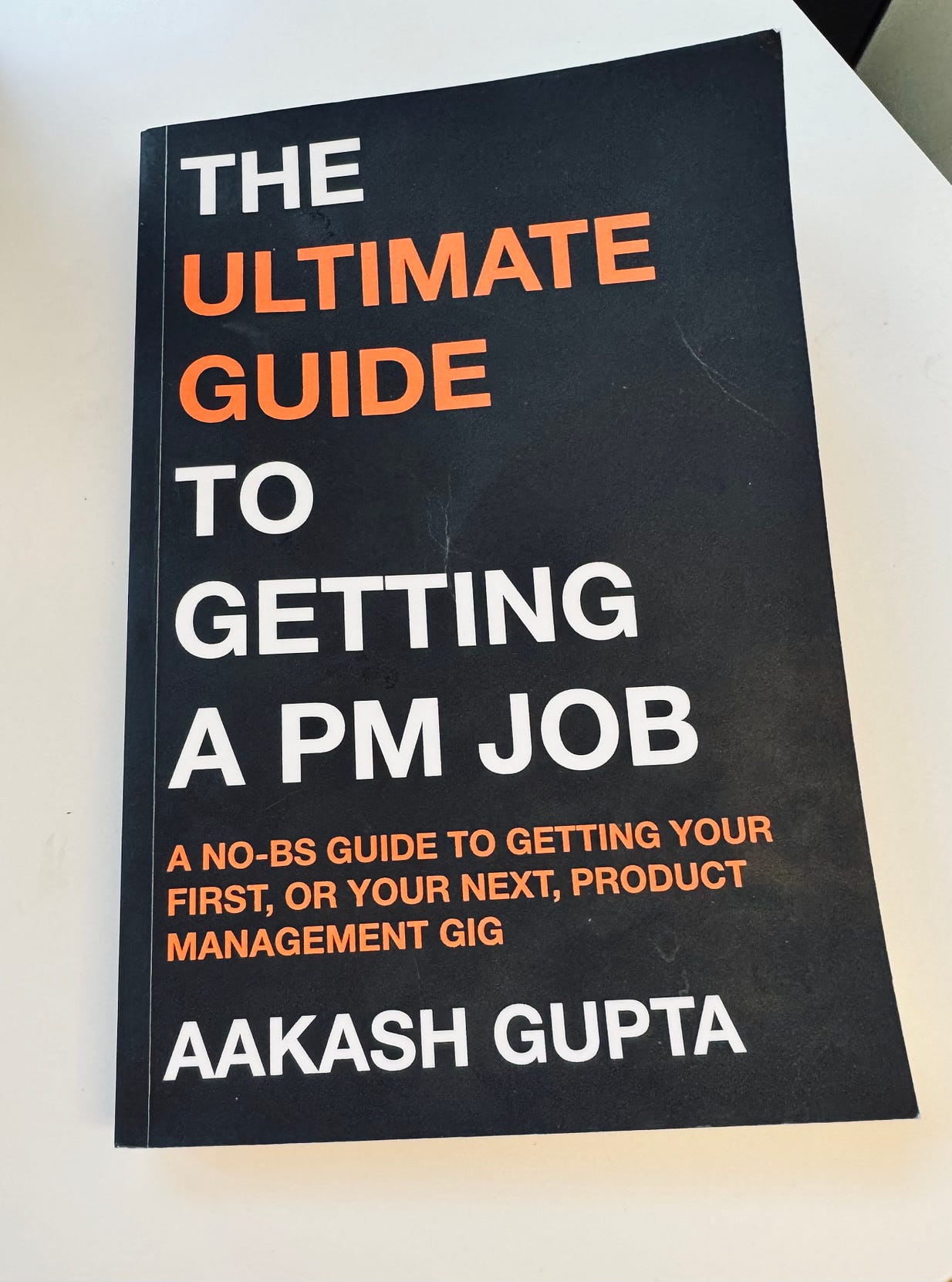
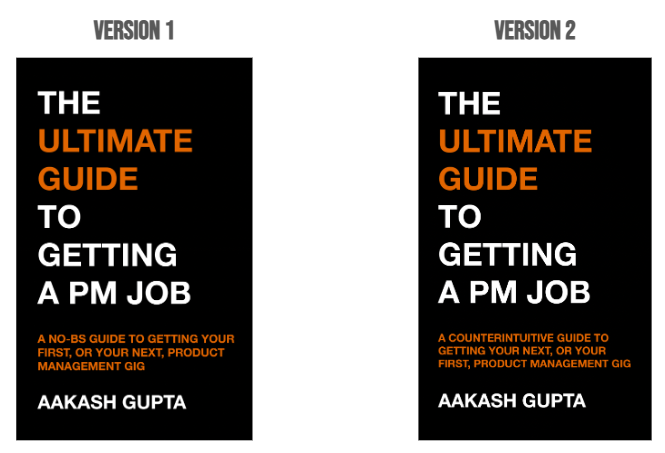
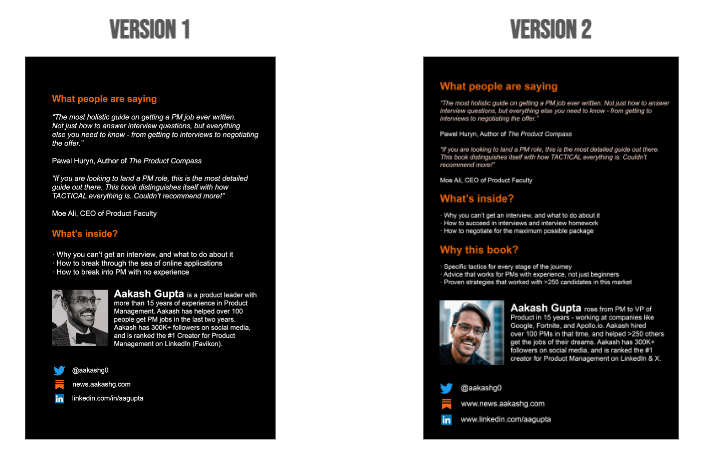
Small Detail 2 - New CoverI like edgy writing, but “No-BS” didn’t get the message across for everyone. I interviewed several folks who said they found it to not resonate, especially given the content. My writing style is edgy, but it doesn’t use swear words. My writing generally is surprising, not what people expect. I decided a better word was counterintuitive:
So that was the front. On the back, I’ve changed my own mugshot branding everywhere, so I updated that. I also wanted to update the story about me and better reflect the new information the book contains:
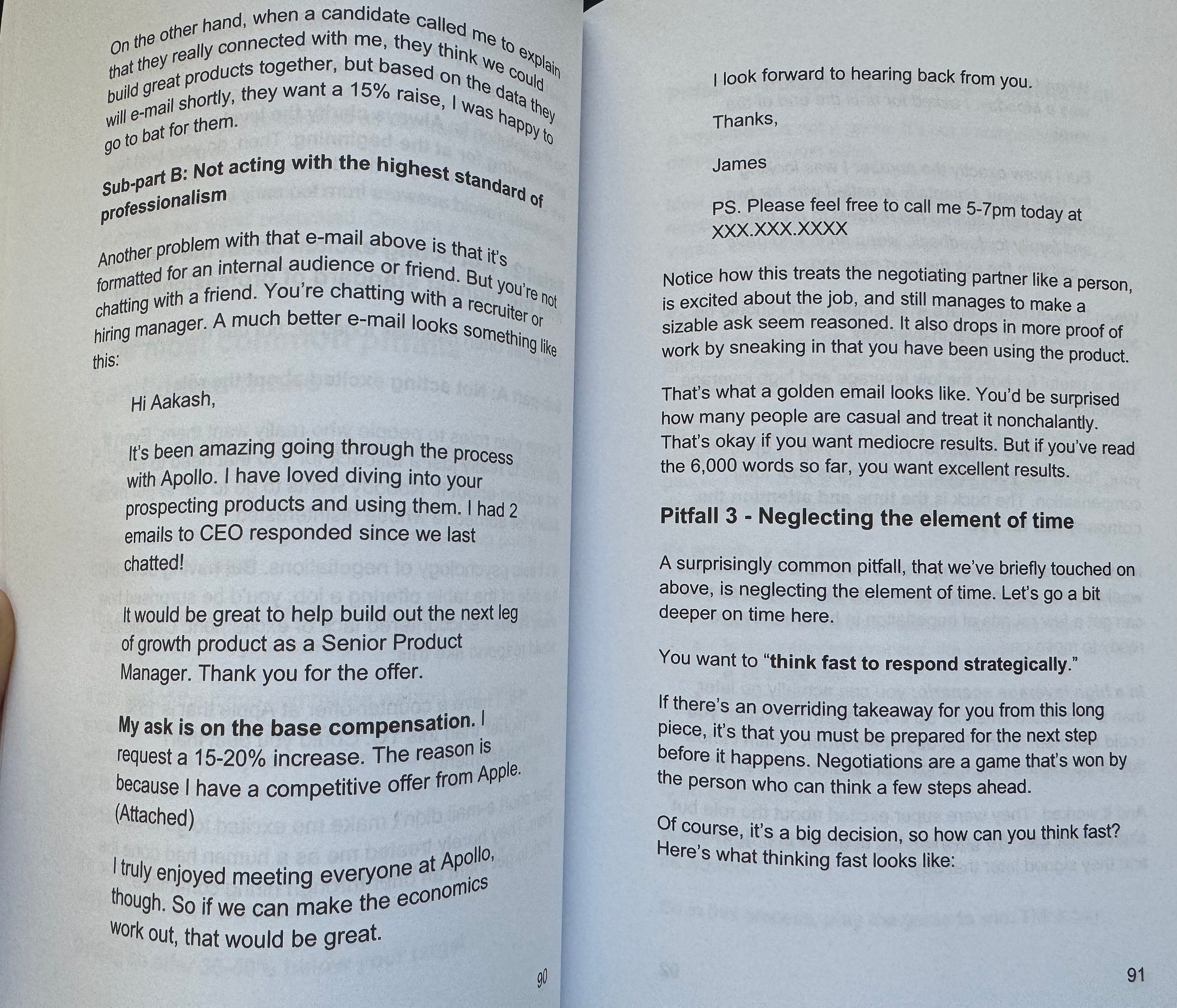
I also made an edit to the Spine. I made the title thicker so it pops more in your bookshelf. Overall, all the small details add up to a much better cover, if I do say so myself. Small Detail 3 - New Page Numbers & HeadersAs I was flipping through the pages of version 1, I realized the page numbers were sometimes hidden.
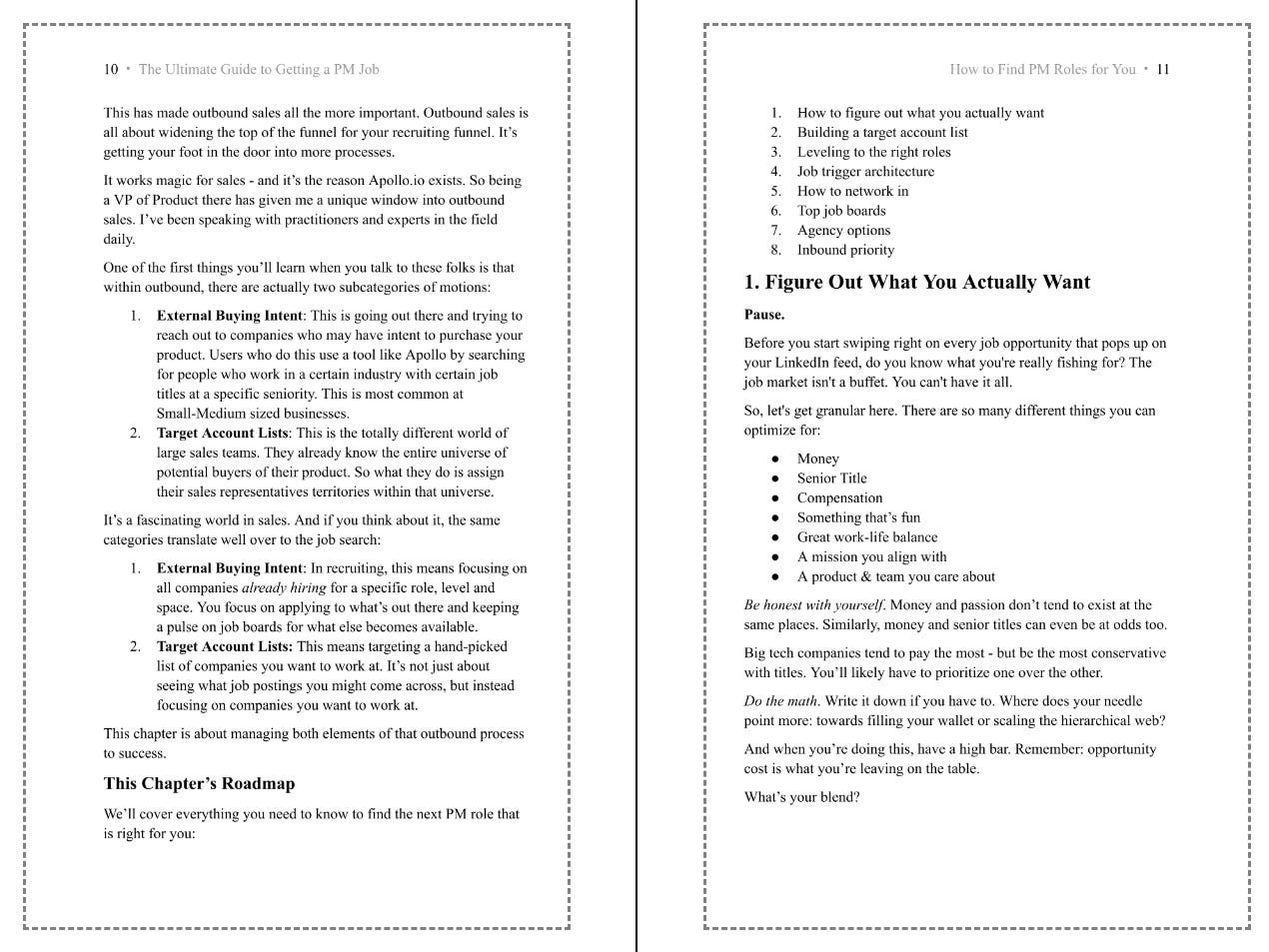
Originally, I thought, “Oof. The perils of self-publishing.” Then, I realized the issue was just on even numbered pages. So I changed the numbering on even pages to the outside edge. Then, I took inspiration from several other Amazon KDP books on my bookshelf. I realized I had an opportunity to add more styling to the pages with the book title and chapter title. This has the added benefit of organizational help. You can always refer back to the chapter title:
As I was doing this, I also realized page numbers are easy to thumb through on top. So I moved everything up there. It makes for a much easier, “thumbing through,” experience. Small Detail 4 - Removing Areas of Self-PromotionThere were some areas in the first version where I was “justifying the book.” I thought this was a fairly common pattern with books, but it’s clear the writing didn’t resonate with some. So, I took out the self-promotional content and focused on the facts:
In all but the introduction, where I give a little more color to the self-promotional topics. It’s hopefully a positive change. Each chapter “dives right in.” Small Detail 5 - Being Ruthless With Any Confusing SentencesThe final area I wanted to edit the book for was any confusing phrases. As I’m churning out newsletter issue week after week, sometimes typos or confusing wordings slip through the cracks. I live by the religion:
But with the book, I realized that was different. So, I’ve gone through each word with a fine tooth scalpel. Small Detail 6 - Lower Price, with Lower Profit Margins for MeThe last version of the book was 312 pages. The new version is 353 pages. But, in almost all regions, the new version of the book is priced lower. Moreover, the words on the pages are more compact. I’ve reduced spacing after paragraphs and the shift to a Serif font also added more words per page. So the latest version of the book is 85K words vs 57K words for the prior version of the book. All of that has meant a full 50% compression in my profit margin per book. That’s how much those review matter to me! I’m hoping the ROI of the book is much clearer with better content and a lower price.
That’s been my process with Version 2. I hope it resonates! For the next 7 days, version 2 is available for Paid Newsletter subscribers:... Subscribe to Product Growth to read the rest.Become a paying subscriber of Product Growth to get access to this post and other subscriber-only content. A subscription gets you:
|





This week’s system design refresher: Top 9 Most Popular API Protocols (Youtube video) What is a deadlock? What’s the difference between Session-based authentication and JWTs? Top 6 ElasticSearch Use Cases Top 9 Cases Behind 100% CPU Usage SPONSOR US ͏ ͏ ͏ ͏ ͏ ͏ ͏ ͏ ͏ ͏ ͏ ͏ ͏ ͏ ͏ ͏ ͏ ͏ ͏ ͏ ͏ ͏ ͏ ͏ ͏ ͏ ͏ ͏ ...
Comments
Post a Comment