Latest articlesIf you’re not a subscriber, here’s what you missed this month.
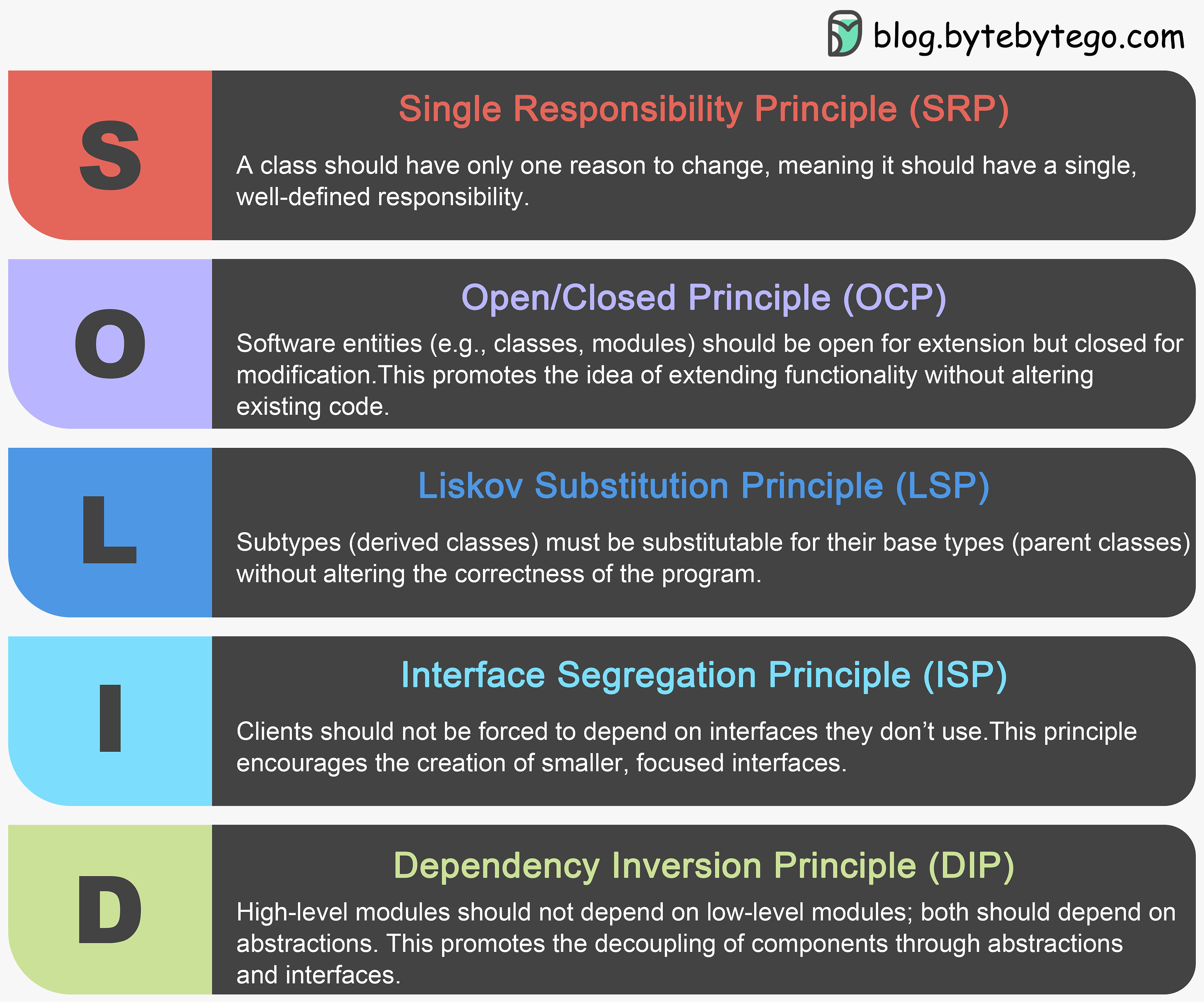
To receive all the full articles and support ByteByteGo, consider subscribing: In the fast-paced world of software development, writing robust, maintainable, and scalable code is critically important. One way to achieve this is by following a set of fundamental design principles known as the SOLID principles. These principles provide a clear framework for crafting software that is easy to understand, extend, and maintain. In this newsletter, we will explore the SOLID principles, examining each component in detail. We will review practical implementation guidance and best practices for applying them. Now, let's begin our exploration with a brief overview of the SOLID principles first. A Brief OverviewThe SOLID principles are a set of five fundamental design principles that were introduced by Robert C. Martin to guide software developers in creating maintainable, scalable, and flexible software systems. These principles, when followed, contribute to the development of software that is easier to understand, modify, and extend over time. The SOLID acronym stands for:
Importance of Design Principles in Software DevelopmentDesign principles, such as the SOLID principles, play a pivotal role in the software development process for several reasons:
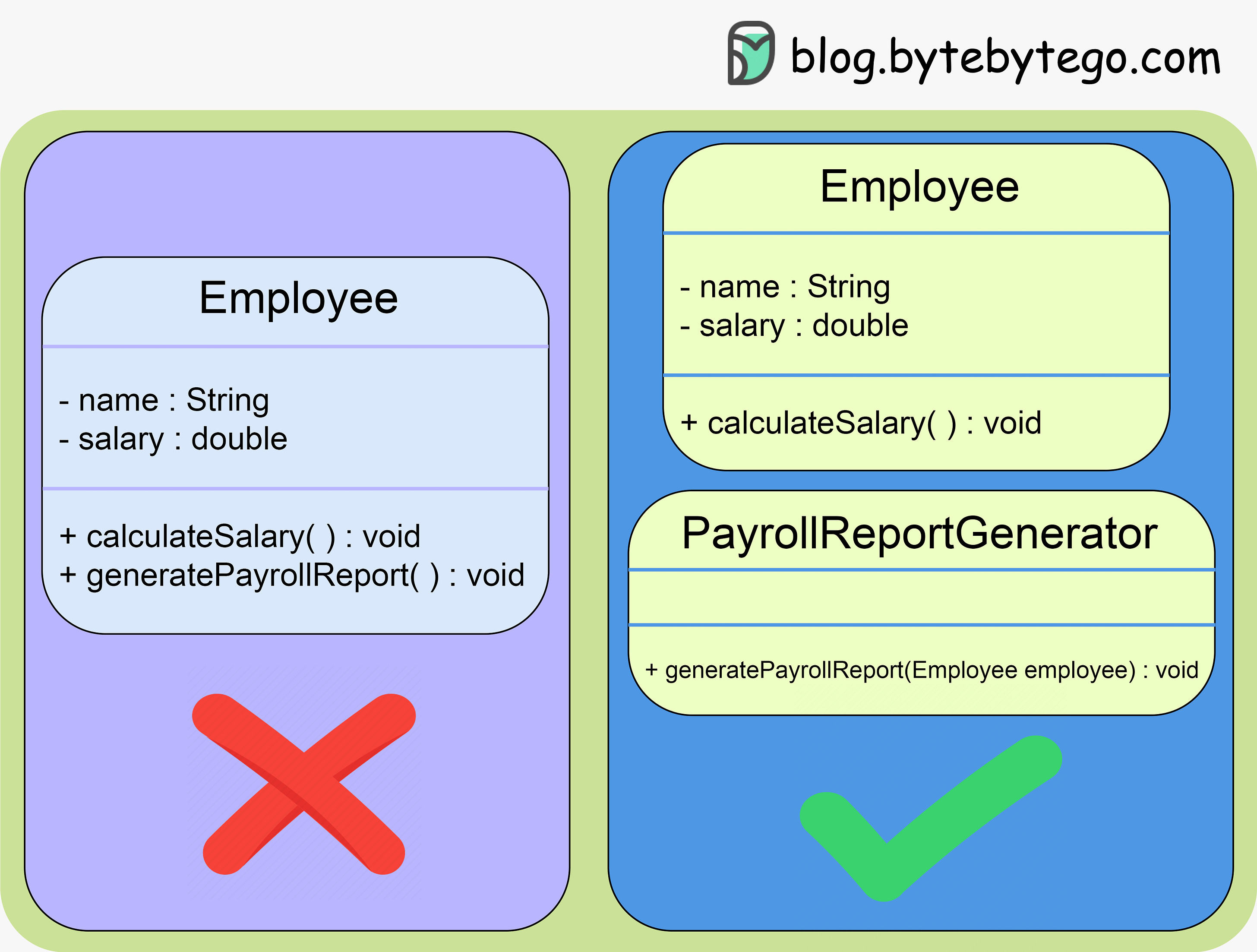
Now, let's deep dive into each component of the SOLID principles. Single Responsibility Principle (SRP)The “S” in the SOLID principles stands for the Single Responsibility Principle (SRP), which states that a class should have only one reason to change or, in other words, it should have a single, well-defined responsibility or job within a software system. Illustrating a Violation of SRPLet's take a look at a Java code example below that clearly violates the Single Responsibility Principle (SRP) principle: In the above example, the Employee class has two responsibilities: calculating an employee's salary and generating a payroll report. This violates the SRP because it has more than one reason to change. Fixing the Violation (SRP)To address the violation of the Single Responsibility Principle (SRP) in our previous example, let's refactor the code to separate concerns and ensure that each class has a single, well-defined responsibility. We'll create distinct classes for calculating an employee's salary and generating a payroll report: In the refactored solution, the responsibilities of calculating the salary and generating a payroll report have been separated into two distinct classes (Employee and PayrollReportGenerator), each with a single responsibility. This adheres to the SRP. Let’s take a look at the visual representation of the classes and implementation of the single responsibility principle (SRP).
Keep reading with a 7-day free trialSubscribe to ByteByteGo Newsletter to keep reading this post and get 7 days of free access to the full post archives. A subscription gets you:
|





This week’s system design refresher: Top 9 Most Popular API Protocols (Youtube video) What is a deadlock? What’s the difference between Session-based authentication and JWTs? Top 6 ElasticSearch Use Cases Top 9 Cases Behind 100% CPU Usage SPONSOR US ͏ ͏ ͏ ͏ ͏ ͏ ͏ ͏ ͏ ͏ ͏ ͏ ͏ ͏ ͏ ͏ ͏ ͏ ͏ ͏ ͏ ͏ ͏ ͏ ͏ ͏ ͏ ͏ ...
Comments
Post a Comment