Talk to VCs at Index, Sequoia and Coatue, and they’ll tell you: the best performing company in their portfolio is Notion. With whispers of a layoff at Canva, and a wave of senior departures at Miro, Notion has firmly taken the throne as the world’s hottest PLG company. So - in today’s piece, we’re going to break down the world’s most interesting SaaS. Introducing KartikToday’s piece was written with Kartik Arora, a PM based in Delhi who has worked in SaaS at HSV Digital, TheHouseMonk, and Info Edge India.
He’s on the market now for PM roles: LinkedIn. Today’s PostWe interviewed 3 current employees at Notion, 2 former employees, used the product for months, and read everything on the internet about the company. Now we’re ready to present our analysis:
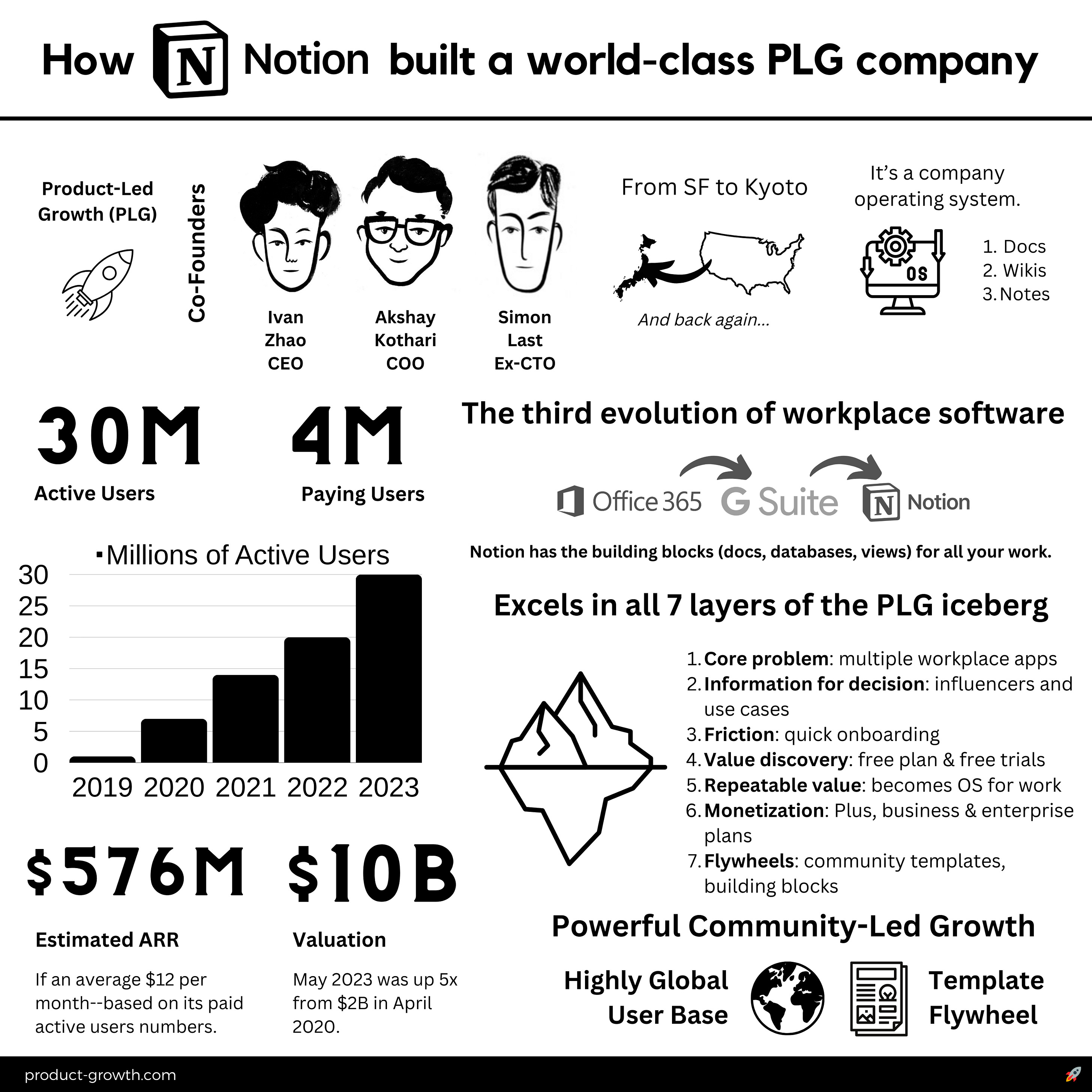
Part 1 - Notion’s StoryPeople have always been looking for ways to be more productive, be it through the use of tech, strategies, or frameworks. In the last 5 to 6 years, we have seen a litany product launches around productivity: Miro, Canva, Coda, Tome, and more. Standing out amidst all that noise, Notion has become synonymous with productivity and collaboration. The $10B valued company has built a product that now caters to 30M users and generates an estimated annual revenue of >$567M. But Notion has had its share of obstacles along the way. Chapter 1 - From a Failed StartupThe story begins in 2015 San Francisco. Ivan Zhao and Simon Last’s previous startup, focused on No-code, failed.
Ivan took a $150K loan from his mom, and moved with Simon to Kyoto. It was much cheaper. And it had one benefit:
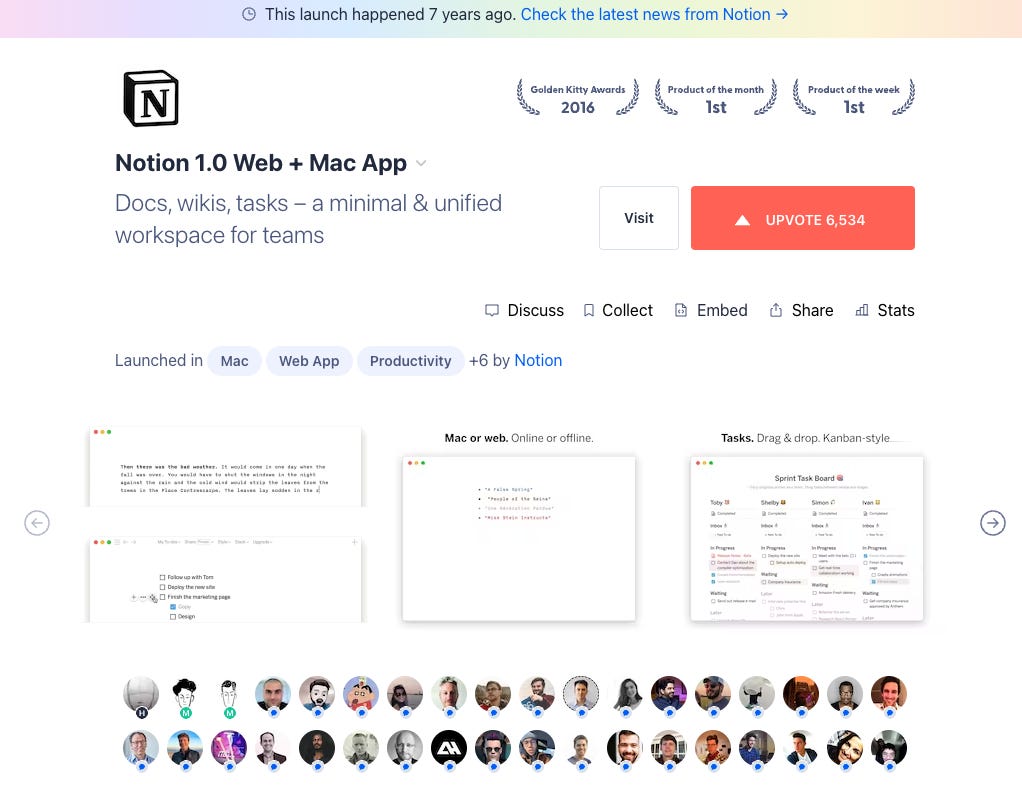
This allowed the pair to focus on solving a problem that they had faced: workplace software was so diverse. That’s where they dreamt up the idea of a “post-file, post-MS Office world.” After a year of intense coding in their underwear, they launched. Notion 1.0 won #1 ProductHunt Product of the Day in 2016:
Chapter 2 - Finding Product-Market Fit“Docs, wikis, tasks” would turn out to be a perfect description for where Notion found product-market fit. Those three use cases all resonated with users. The Wikis Use CaseA particularly powerful use case was Wikis. In 2016, the main competitor for wikis was Atlassian’s Confluence. Notion was cheaper, more user-friendly, though less full-featured. Less technical users like designers and business-people loved it. As its normal sweet spot, Atlassian was best at building for software engineers. This helped Notion carve out a clear niche in Wikis. Wikis also proved to be a fairly sticky way to enter companies - and would provide fuel for the company’s eventual vision of becoming a company operating system. Amazing LaunchesNotion would go on to nail its first few launches:
By June, 2017, Notion had made a sticky product that users were using on every device. Notion 2.0After all the iterations, Notion 2.0 was launched in 2018. It represented a culmination of Notion’s better way to work
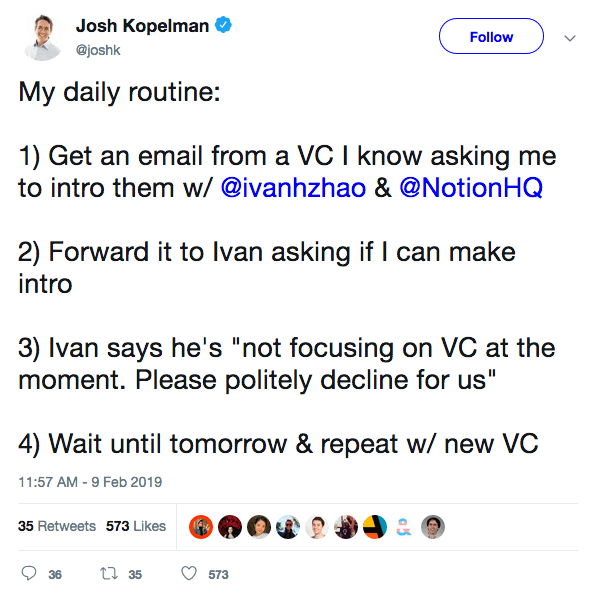
It was, again, the #1 product on Product Hunt. With merely 10 employees, Notion reached 1 million active users. A prominent feature in The Wall Street Journal also helped. The result was a torrent of interest from VCs to invest. Initially, Notion stayed careful in its growth:
Chapter 3 - Building Out a PLG EngineBut after years of courage to wait, Notion accepted its first VC funding in July 2019. Of course, it did it on its own terms: A mere $10M at a valuation of $800M. In other words, selling just 1.2% of the company. By that time Notion had cemented its three key use cases: notes, docs, and task management in that order. And the differentiation was clear as well:
This allowed the company to begun to double down on growing the company. Notion supplemented its war chest with additional VC raises:
The added gasoline made Notion’s flame burn even brighter. It hired folks like:
Notice who those folks are not: sales leaders. These are product leaders. Chapter 4 - Present-Day SuccessNow with more than 500 employees, the company has reached true scale. Despite that, only 10% of those employees are in sales. It has stayed true to its product-led growth motion. This is the typical march for PLG SaaS companies: Hire great product leaders in key segments to double down. Based on the latest shared data, Notion has over 30M users, out of which 4M are paying users. That gives it an estimated ARR of around ~$567M. (We wouldn’t be surprised if that 4M number is outdated and that figure is significantly higher.) Public company Asana, in a similar space has a yearly revenue of $167M. Notion has clearly “made it.” The question is not “if” it will go public, but “when.” But how did it actually get there from a Product POV? Part 2 - The 7 Layers of Notion’s PLG IcebergLet’s screen-by-screen break down each layer of Notion’s PLG Iceberg:
Keep reading with a 7-day free trialSubscribe to Product Growth to keep reading this post and get 7 days of free access to the full post archives. A subscription gets you:
|






This week’s system design refresher: Top 9 Most Popular API Protocols (Youtube video) What is a deadlock? What’s the difference between Session-based authentication and JWTs? Top 6 ElasticSearch Use Cases Top 9 Cases Behind 100% CPU Usage SPONSOR US ͏ ͏ ͏ ͏ ͏ ͏ ͏ ͏ ͏ ͏ ͏ ͏ ͏ ͏ ͏ ͏ ͏ ͏ ͏ ͏ ͏ ͏ ͏ ͏ ͏ ͏ ͏ ͏ ...
Comments
Post a Comment