Latest articlesIf you’re not a subscriber, here’s what you missed this month.
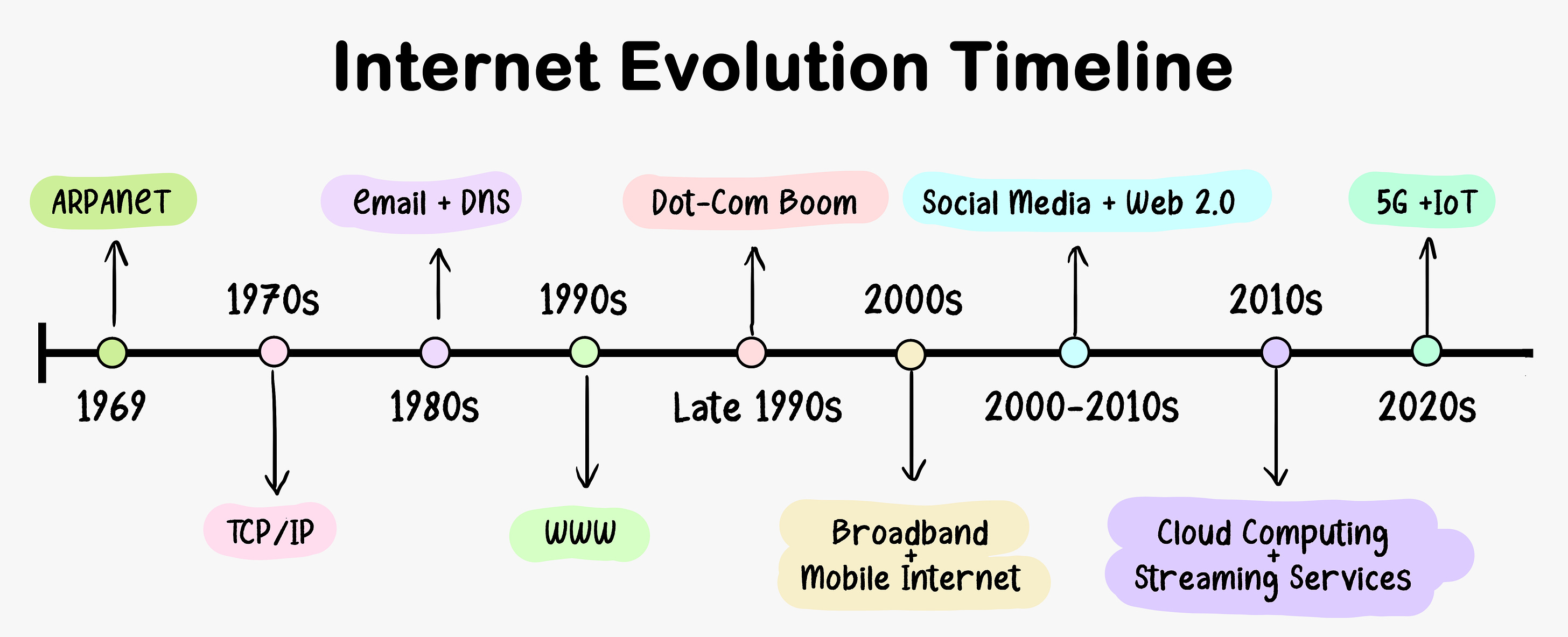
To receive all the full articles and support ByteByteGo, consider subscribing: The Internet has become an integral part of our daily lives, shaping how we communicate, access information, and conduct business. At its core, the Internet is a global system of interconnected computer networks that use standardized communication protocols to facilitate data exchange. This enables the transmission of text, images, videos, and more, across all sorts of devices. In this issue, we dive into the essence of the Internet by exploring its key components: the network edges, access networks, network core, network protocols, and the Internet Protocol stack. We discuss how packet switching, forwarding, and routing work. We unravel the complexities of access networks and examine the crucial role protocols play in governing Internet activities. By the end, you will gain a comprehensive understanding of the Internet's architecture and its pivotal role in modern communication. Internet EvolutionThe evolution of the Internet is a fascinating journey spanning several decades, marked by groundbreaking developments and innovations. Here is a timeline of key milestones and transformative moments in the history of the Internet that have shaped the digital landscape we know today.
Components of the InternetThe Internet is a complex and interconnected network, consisting of several key components. We are going to explore the most important components of the Internet. The Network EdgeThe computers and other devices connected to the Internet are often referred to as end systems. They are called end systems because they sit at the “edge” of the Internet.
The Internet’s end systems include desktop computers, servers, mobile devices, and an increasing number of non-traditional “things” like smart appliances and IoT devices are being attached to the Internet as end systems. End systems are also referred to as hosts because they host application programs such as a web browser, web server, e-mail client, or e-mail server. Hosts are sometimes further divided into two categories: clients and servers. Informally, clients tend to be desktop and mobile PCs, smartphones, and similar personal computing devices, whereas servers tend to be more powerful machines that store and distribute web pages, stream video, relay e-mail, and similar services. Today, most of the servers providing search results, e-mail, web pages, and videos reside in large data centers.
Access networksHaving considered the applications and end systems at the “edge of the network,” let’s next consider the access network, which is the network that physically connects an end system to the first router (also known as the “edge router”) on a path from the end system to any other distant end system. Access networks serve as the crucial link between end systems and the broader network infrastructure. Access networks can be broadly categorized into three types. Home Access NetworksHome Access Networks refers to the set of technologies that enable connectivity and communication within a residential environment. This network allows devices within the home to connect to the Internet, share data, and communicate with each other.
Institutional Access NetworksInstitutional Access Networks refers to the networking infrastructure and technologies used by organizations, institutions, and businesses to connect to the Internet and facilitate communication within their premises. These networks are designed to handle the specific needs and requirements of large-scale operations.
Mobile Access NetworksMobile Access Networks refer to the various technologies that enable mobile devices, such as smartphones and tablets, to connect to the Internet and communicate with each other. These technologies facilitate wireless communication and data transfer for mobile users.
Keep reading with a 7-day free trialSubscribe to ByteByteGo Newsletter to keep reading this post and get 7 days of free access to the full post archives. A subscription gets you:
|






This week’s system design refresher: Top 9 Most Popular API Protocols (Youtube video) What is a deadlock? What’s the difference between Session-based authentication and JWTs? Top 6 ElasticSearch Use Cases Top 9 Cases Behind 100% CPU Usage SPONSOR US ͏ ͏ ͏ ͏ ͏ ͏ ͏ ͏ ͏ ͏ ͏ ͏ ͏ ͏ ͏ ͏ ͏ ͏ ͏ ͏ ͏ ͏ ͏ ͏ ͏ ͏ ͏ ͏ ...
Comments
Post a Comment