Latest articlesIf you’re not a subscriber, here’s what you missed this month.
To receive all the full articles and support ByteByteGo, consider subscribing: Microservices are a popular way to structure software systems today. As companies grow bigger and use more cloud computing, microservices help tackle complexity. In this issue, we review some key microservices concepts and common questions that come up in interviews:
Now let’s start with the definition of microservices. 1. What Are Microservices?We can quote from Martin Fowler and Adrian Cockcroft on key aspects of microservices. From Martin Fowler:
From Adrian Cockcroft:
Key Aspects of MicroservicesFrom the insightful definitions by Martin Fowler and Adrian Cockcroft, we can summarize these key aspects of a microservice architecture:
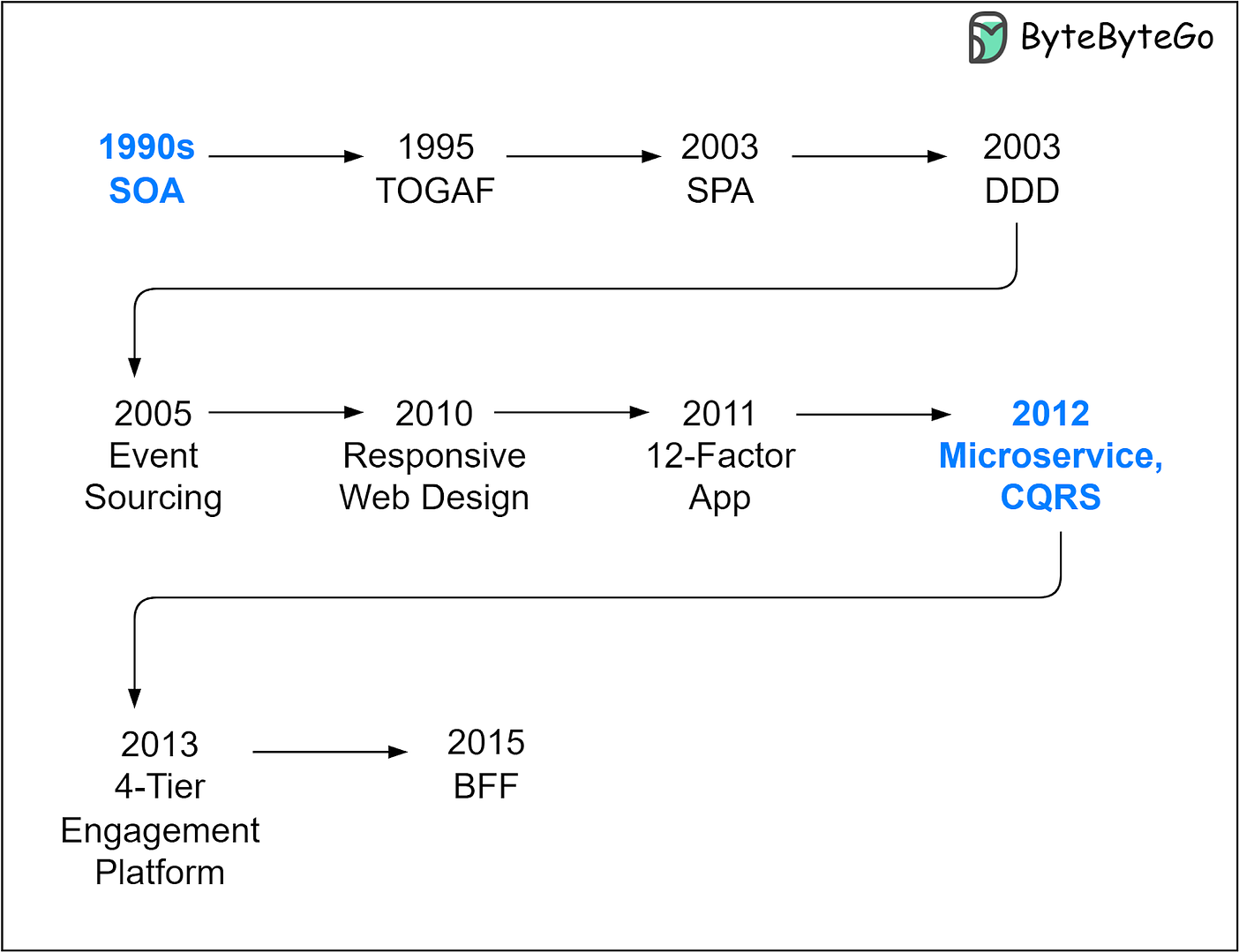
2. What Are the Differences Between SOA and Microservices?Service-oriented architecture (SOA) and microservices architecture styles are important milestones in software architecture's evolution. The diagram below shows the progression of key architectural styles. Service-oriented architecture emerged in the late 1990s to help manage enterprise software systems’ growing complexity. In the 2000s, SOA gained more industry attention and adoption by companies. However, SOA faced implementation complexity challenges. Then in the 2010s, microservices architecture emerged in response to SOA’s limitations. Many large internet companies started adopting microservices to break down their services into smaller components. Microservices gained momentum with cloud computing’s evolution, as containers and orchestration tools made microservices' development, deployment, and monitoring easier.
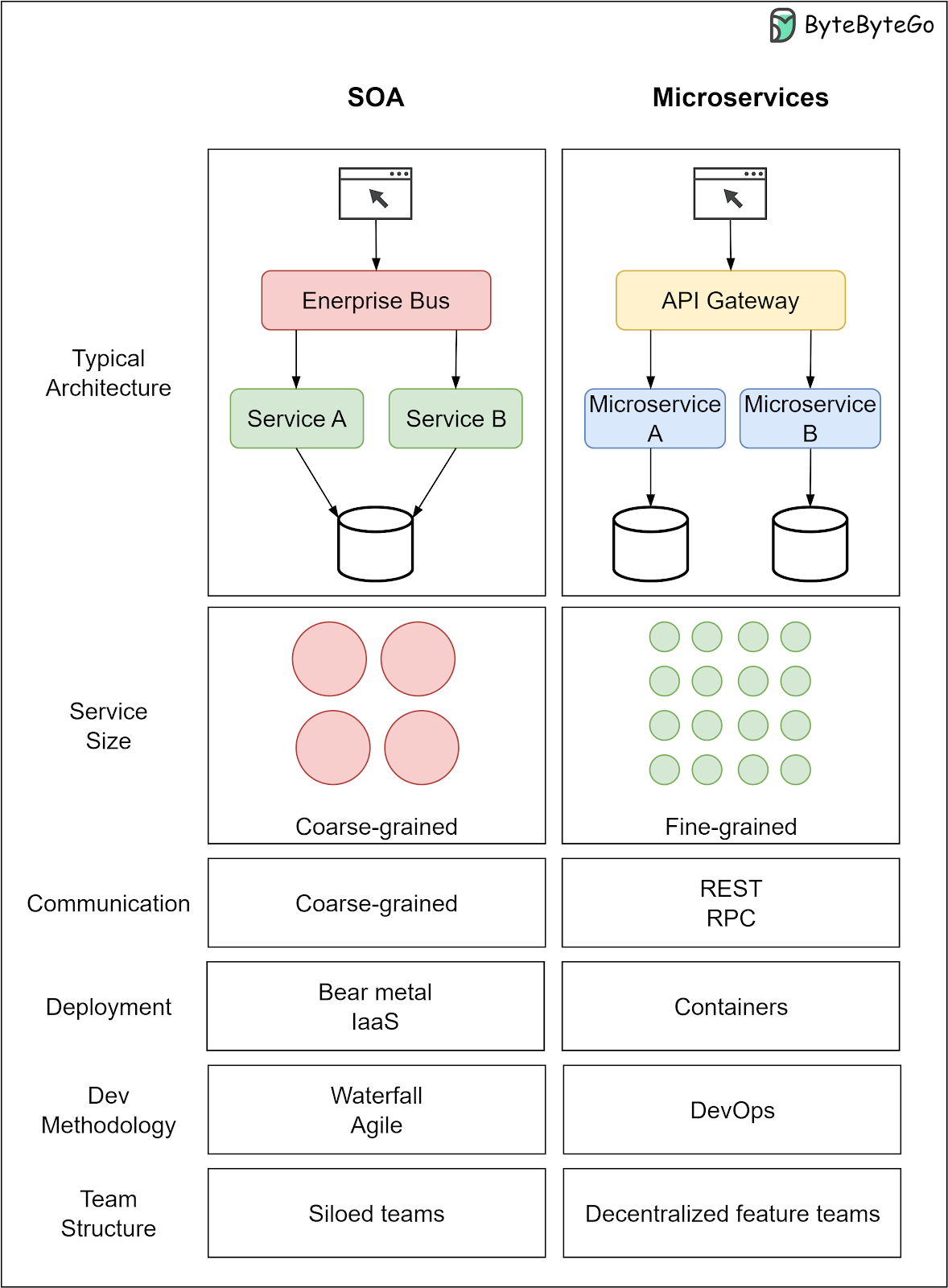
Let’s compare their differences in more detail. The diagram below lists some of the differences. The SOA architectural style offers coarse-grained services, typically a centralized approach where services are grouped by business functions and shared across multiple applications. The microservice style offers fine-grained service granularity through a decentralized approach where small, independent services perform specific functions within an application context. The communication methods also evolve over time. SOA emphasizes uniform communication protocols and standardized interfaces for services to interact. Microservices lean towards diverse communication protocols and interfaces, often based on REST or message queues. Cloud computing has evolved from Infrastructure-as-a-Service (IaaS) to Platform-as-a-Service (PaaS) to container-based PaaS. So microservice-based applications deploy on containers by default. As the technical architecture changes, the organizational structure mirrors it (Conway’s law). So with microservices, the team structure requires multi-functional product teams. Each team focuses on a specific domain.
Keep reading with a 7-day free trialSubscribe to ByteByteGo Newsletter to keep reading this post and get 7 days of free access to the full post archives. A subscription gets you:
|






This week’s system design refresher: Top 9 Most Popular API Protocols (Youtube video) What is a deadlock? What’s the difference between Session-based authentication and JWTs? Top 6 ElasticSearch Use Cases Top 9 Cases Behind 100% CPU Usage SPONSOR US ͏ ͏ ͏ ͏ ͏ ͏ ͏ ͏ ͏ ͏ ͏ ͏ ͏ ͏ ͏ ͏ ͏ ͏ ͏ ͏ ͏ ͏ ͏ ͏ ͏ ͏ ͏ ͏ ...
Comments
Post a Comment