Five Days of Chaos at OpenAI: and What Started ItIt’s been five incredibly turbulent days at the leading AI tech company, with the exit and then return of CEO Sam Altman. Tensions likely started years ago, when their non-profit charter changed.
👋 Hi, this is Gergely with a bonus, free issue of the Pragmatic Engineer Newsletter. In every issue, I cover topics related to Big Tech and startups through the lens of engineering managers and senior engineers. In this article, we cover two out of seven topics from today’s subscriber-only issue: What is OpenAI, Really? To get full issues twice a week, subscribe: OpenAI is the clear leader in the Artificial Intelligence (AI) sector, and probably the hottest company in tech, right now. Just last week, we published the first-ever deepdive into the engineering culture at OpenAI, looking at how ChatGPT ships so ridiculously fast. The short of it is that ChatGPT is a one-year-old-startup within the 3-year-old Applied group. OpenAI has high talent density and tight integration between engineering and research. ChatGPT operates like an independent startup, releasing frequently and incrementally. However, just days after last week’s article, the tech world was shocked as OpenAI suddenly fell into crisis – with the risk it might even cease to exist. Last Friday, the company’s board fired CEO Sam Altman, and cofounder Greg Brockman also quit. By Sunday, employees were revolting and demanding Sam and Greg be brought back. By Monday, OpenAI had hired a new interim CEO, and Altman and Brockman had announced joining Microsoft to head up a newly created AI division. By Monday night, 743 of the 778 OpenAI employees had signed a petition threatening to follow Sam and Greg by joining Microsoft unless OpenAI’s board resigned and Sam returned as CEO. That same day, Microsoft confirmed it was ready to hire all OpenAI staff. For a few hours, there was a very real possibility that OpenAI would shrivel to 30 employees, with 95% of OpenAI’s staff becoming Microsoft employees overnight. Finally, on Tuesday night OpenAI’s board announced that an agreement had been reached, where Sam Altman returns as CEO, the board is updated, and things get mostly back to normal. Last week, Evan Morikawa, who leads around half of OpenAI’s engineers, shared insights about its engineering culture in this newsletter. On Wednesday, he summarized events as “the most insane 100 hours of my career.” Today, we analyze what happened, what caused this sudden near-death experience for OpenAI, and go into how OpenAI’s odd for-profit inside a nonprofit structure caused conflicts that likely led to last week’s events. In this issue, we cover: 1. Five days of chaos: the timeline
2. From nonprofit, to making profits part of compensation packages Let’s jump in: 1. Five days of chaos: the timelineWe’ll use PST (pacific standard time/California time) for all timestamps. OpenAI is headquartered in San Francisco, where events unfolded Friday, 17 Nov: The firingNoon (12pm): Sam Altman, CEO of OpenAI and board member, joins a board meeting to which he was invited. At this meeting, he’s sacked, effective immediately. The board has 6 members, including Sam. The board’s chair, Greg Brockman, is not present. 12:19pm: Greg Brockman, cofounder of OpenAI, its president, and chair of the board, gets a message from Ilya Sutskever, cofounder, chief scientist, and fellow board member. Ilya asks Greg for a quick call. 12:23pm: Greg joins a Google meet with the other 4 board members. He’s told he is to be immediately removed from the board, and that Sam has been fired. OpenAI publishes a blog post at the same time announcing this firing, writing:
1:46pm: Sam Altman announces on Twitter that his time at OpenAI is over, saying he’ll have more to say about what’s next, later. 4:00pm: Greg Brockman sends a message to the OpenAI team:
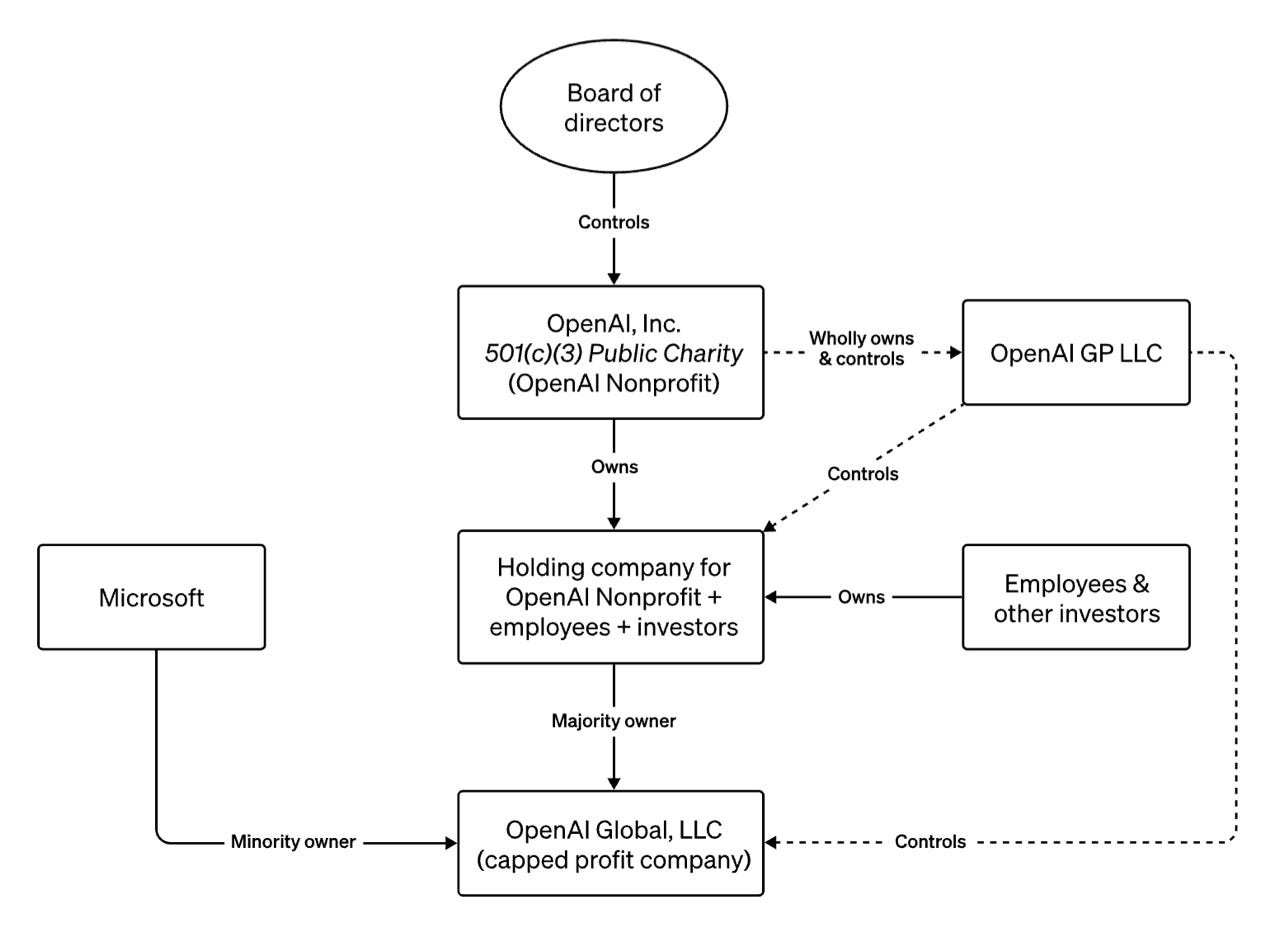
With each development, the reaction is disbelief inside and outside OpenAI: Sam fired; what? Greg quit; how? After all, Sam Altman was the public face for OpenAI for four years; the leader who championed the wildly successful ChatGPT. Greg had been there since the start of OpenAI and was a popular leader, like Sam. The story of OpenAI’s board firing Sam Altman became the most upvoted story on Hacker News in the past five years, indicating just how unexpected and impactful it was for the tech community. The story is the third most upvoted of all-time, behind Stephen Hawking’s passing, and the news of Apple rejecting to install a backdoor on iOS that the US government requested. OpenAI’s board dynamicsSo how did this firing take place, and what about the board which executed it? To understand this, here’s an overview of OpenAI’s admittedly exotic corporate structure, from its website:
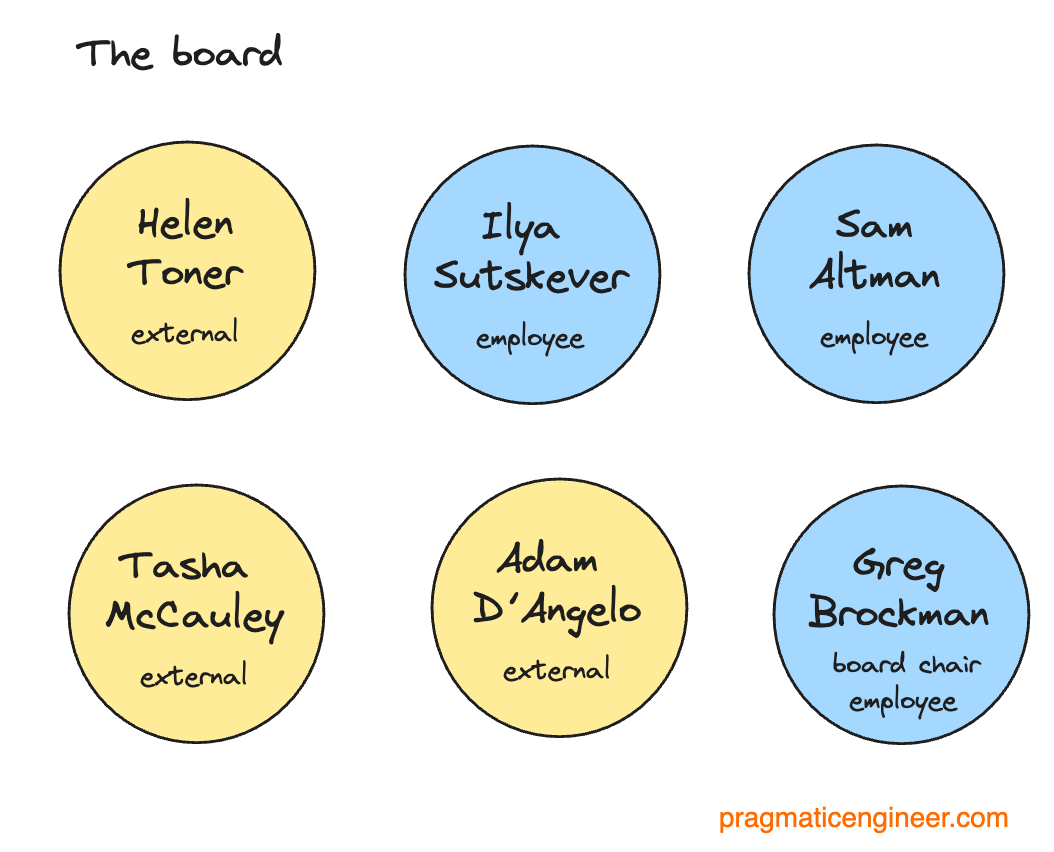
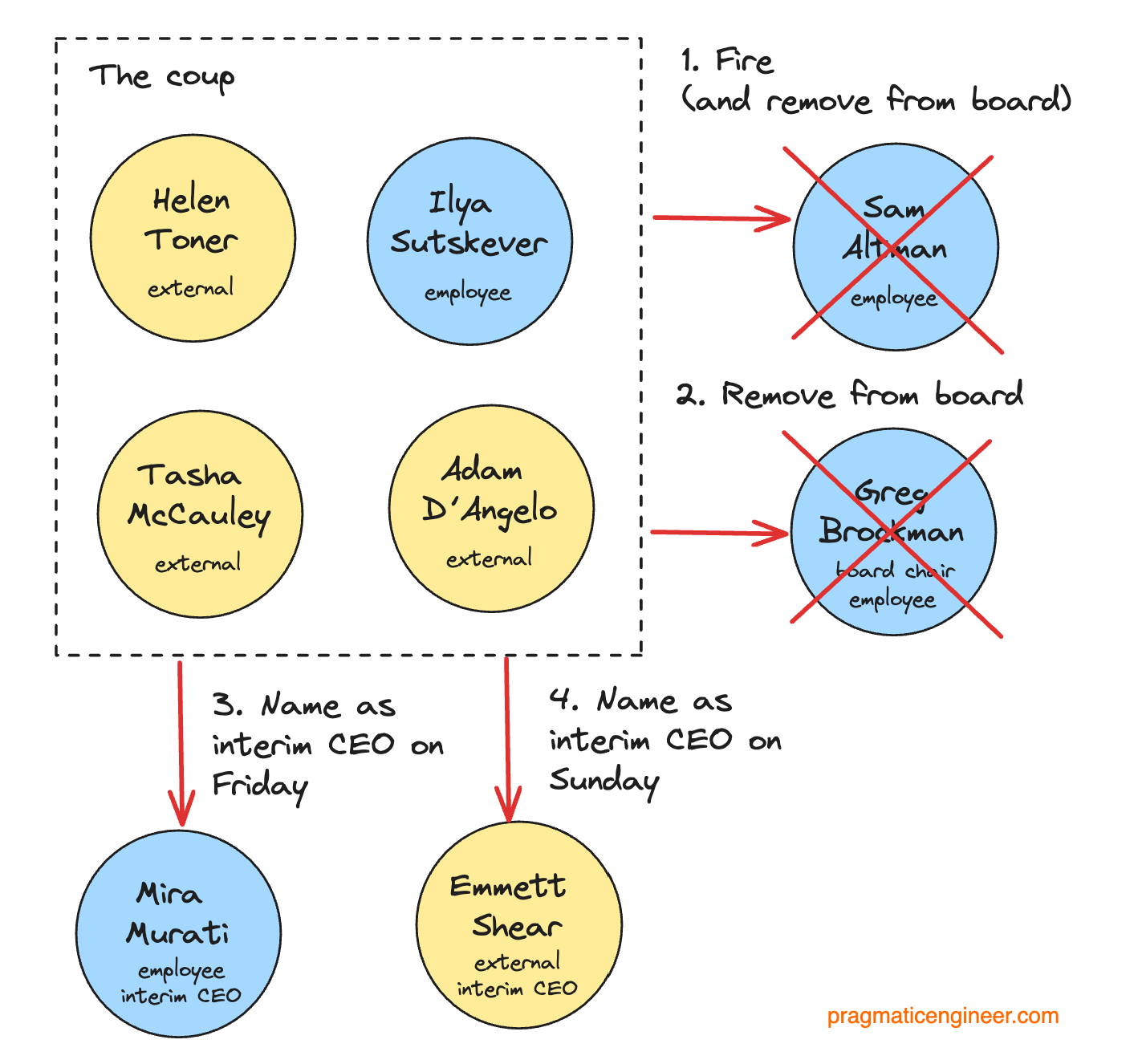
OpenAI started as a nonprofit in 2015, and the board controls this nonprofit. In 2019, a “capped profit” company was created, which we’ll go into later. The nonprofit owns and controls this for-profit part of OpenAI, as well. Sam Altman was CEO of the OpenAI nonprofit, and the board controls the nonprofit. OpenAI’s board of directors consisted of six people before noon on Friday, and looked pretty well balanced; with an equal number of employees represented as there were non-employee board members:
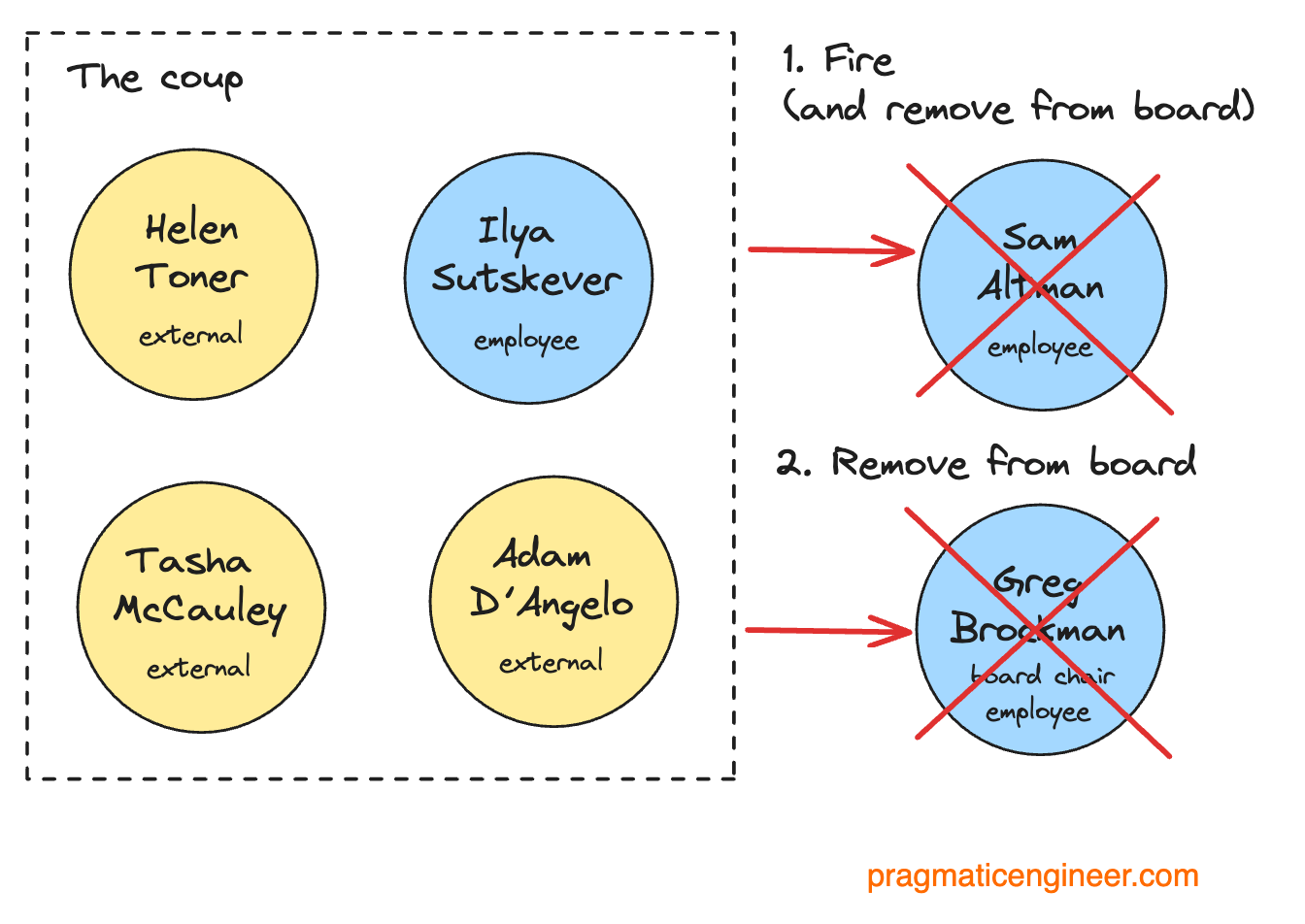
This dynamic changed rapidly, when four board members ganged up to remove the other two:
Interestingly, the board acted without the chair, which could raise some governance questions. Also, we later learned that OpenAI’s biggest investor, Microsoft – which has invested $10B in January 2023 – was not notified of the firing in advance. Saturday, 18 Nov: fury at MicrosoftOn Saturday, confusion reigned. The board wrote: “[Sam] was not consistently candid in his communications with the board, hindering its ability to exercise its responsibilities.” What did this vague statement really mean? Had Sam hidden essential details, or withheld vital information? No such details were released. What did emerge, however, were details on who organized this coup, and Microsoft’s anger about it. From Ars Technica:
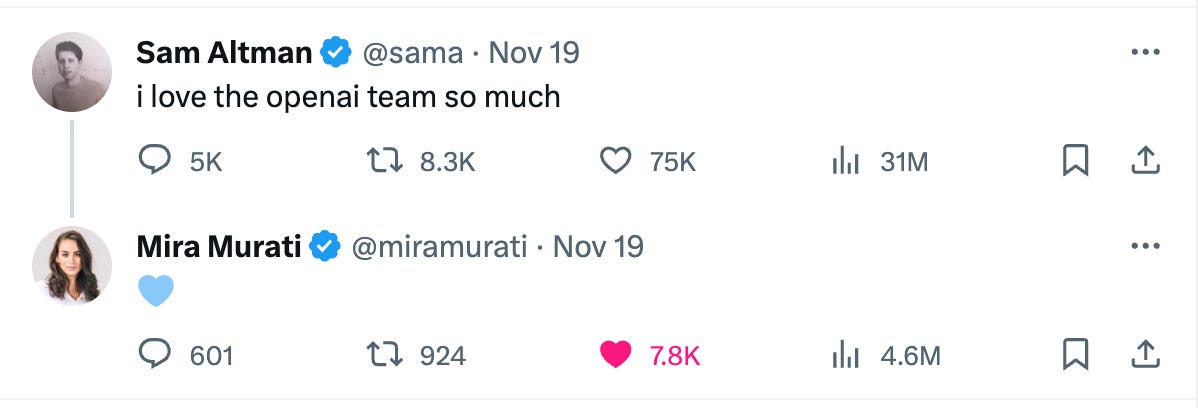
OpenAI staff signals strong public support for Altman. Around 9pm, Altman tweets: “i love the openai team so much.” In response, hundreds of OpenAI staff respond with a heart emoji, indicating their support. It’s rumored those responding could be ready to quit OpenAI to follow Sam wherever he goes next. Interim CEO Mira Murati also responds with a heart, indicating she is with “team Sam:”
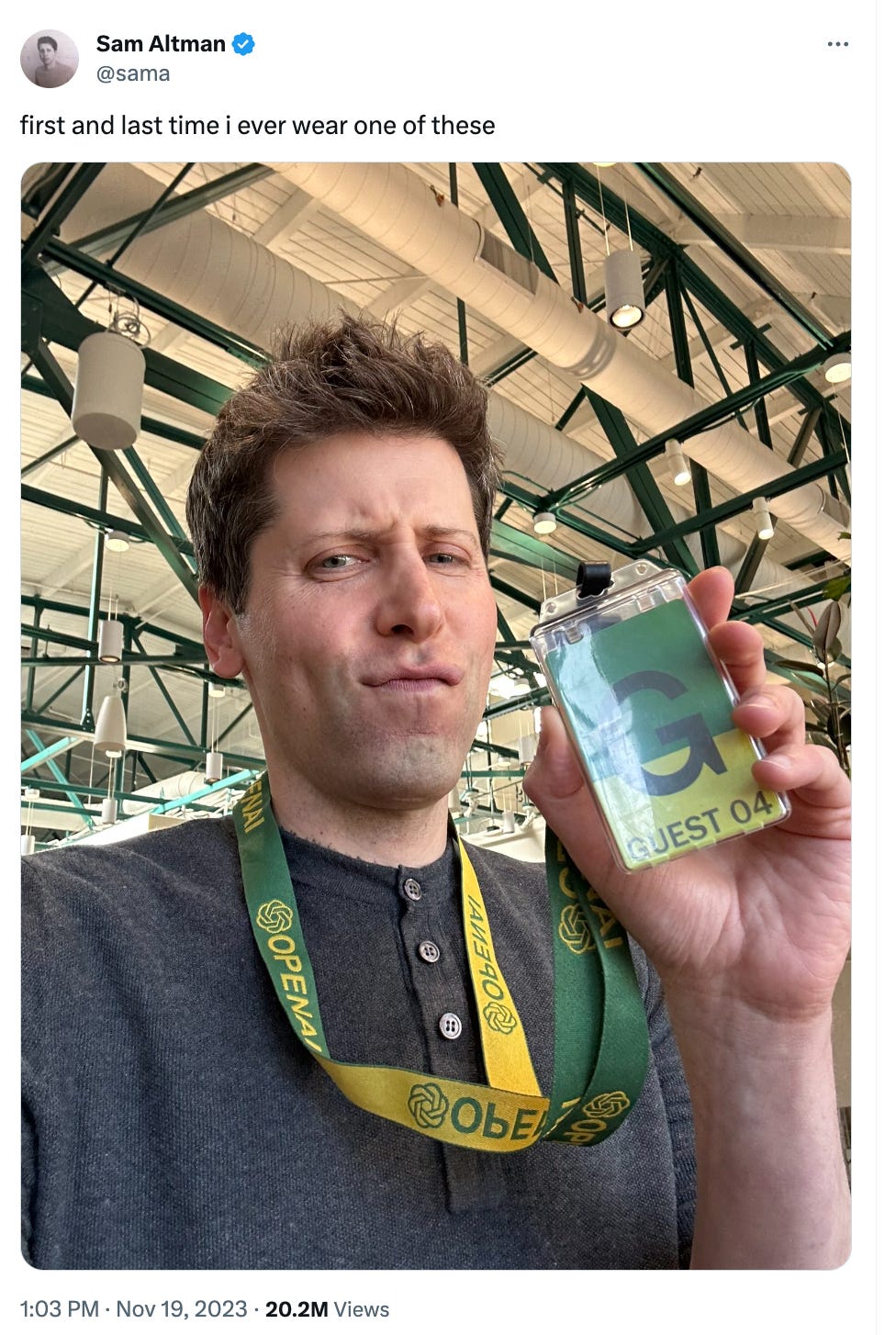
This event was the first public indication of employees’ overwhelming support for Sam and Greg. Sunday, 19 Nov: efforts to undo the messInvestors – especially Microsoft – are unhappy, and start an attempt to reinstate Altman as CEO. As Microsoft is a massive investor, it’s reasonable to expect the company has a big say, and can get Sam Altman back to leading the company before the markets open on Monday. The markets matter to Microsoft because without a resolution, its stock price could lose value thanks to its financial links to OpenAI. 1pm: Altman enters OpenAI’s offices to meet the board and discuss his possible return. Before going into the meeting, he posts on social media, sending a message to the board that it’s the first and last time he’s taking a guest badge at the company he ran for four years:
Key staff inside OpenAI who are pushing for Altman’s return to the CEO role, include interim CEO, Mira Murati, chief strategy officer, Jason Kwon, and chief operating officer, Brad Lightcap, as per Bloomberg. 5pm: the deadline for the board to agree to Altman’s demands. Nothing is announced 9pm: OpenAI gets another new CEO. In a further unexpected twist, the board does not announce Altman will return as CEO as investors have pushed for, but does name an new interim CEO; Twitch cofounder, Emmett Shear. He later shares that he made the decision within a few hours of getting the call from the board. Before offering the CEO role to Emmett, the OpenAI board offered it to former GitHub CEO, Nat Friedman, and to Scale AI CEO, Alex Wan. Both declined. The board very clearly did not want Altman and was scrambling to find a new interim CEO because the first interim, Murati, also wanted Altman back:
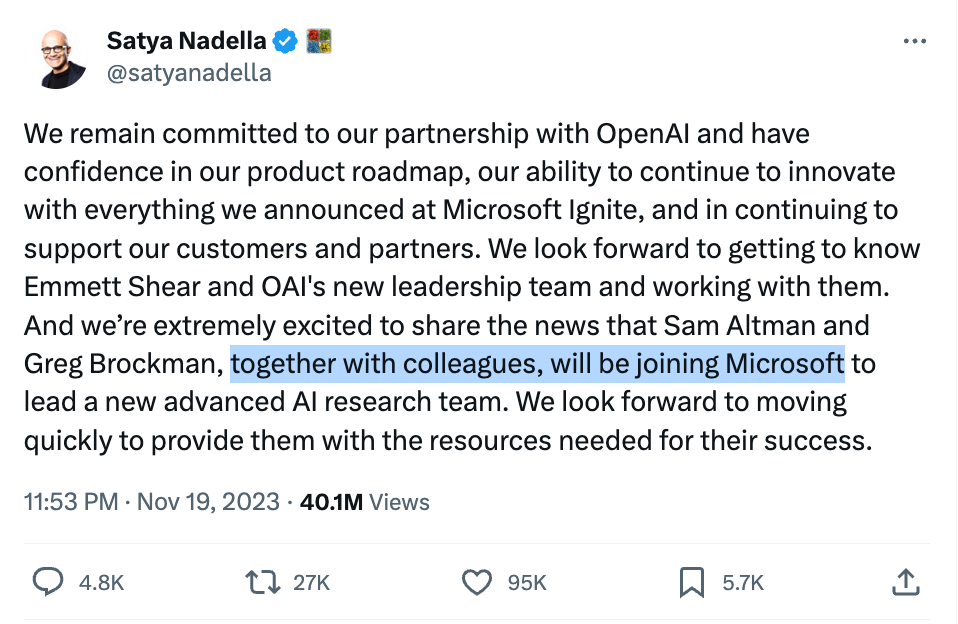
Employees refuse to attend an emergency all-hands. Following Shear’s appointment as CEO, a last-minute all-hands meeting is organized. Staff refuse to attend, and several people responded with a “fuck you” emoji, as per The Verge. 11:53pm: Sam to join Microsoft? Satya Nadella drops another bomb. Responding to OpenAI’s CEO announcement, the Microsoft CEO tweets that Sam and Greg are joining Microsoft, “together with their colleagues.” Remember those hearts replies under Altman’s earlier tweet? The signals are that a brain drain from OpenAI to Microsoft is imminent:
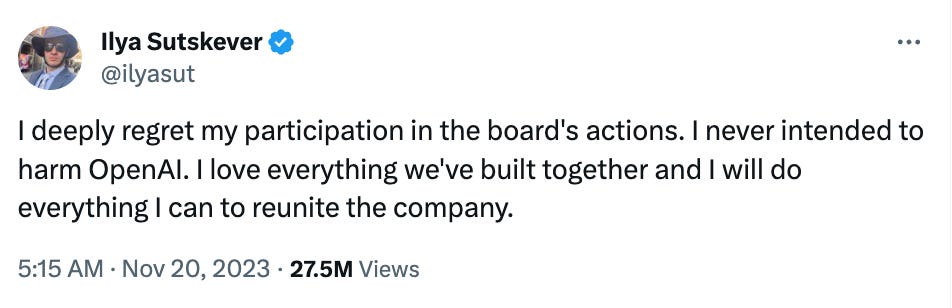
Monday, 20 Nov: events speed up5am: Ilya Sutskever, supposedly the organizer behind the coup, announces a full-reverse:
This means that on the remaining 4-person board, only 3 members now back the coup, with one, Sutskever, on “team Sam.” Could this mean there’s hope of reversing the board’s actions? What about Microsoft’s CEO tweeting that Sam and Greg are to become Microsoft employees? An employee revolt gathers momentum, and threatens OpenAI’s existence. Around 1:30am, employees started a petition, threatening:
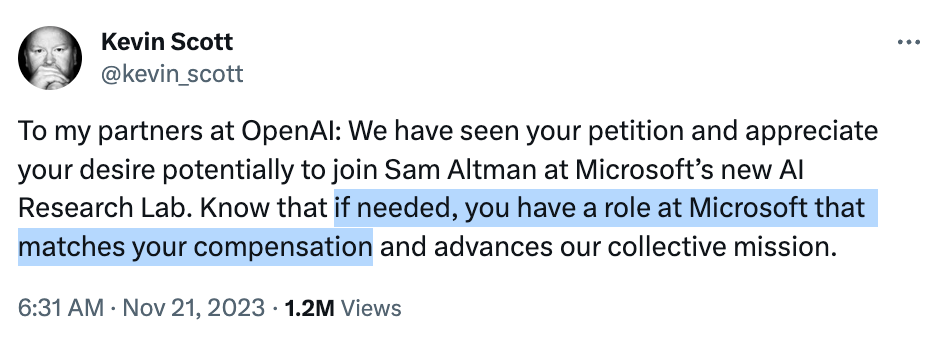
At 2am, former interim CEO Mira Murati tweeted “OpenAI is nothing without its people” – and yet again, hundreds of OpenAI staff copy-post this phrase as a sign of defiance. Those posting this tweet also sign the petition. By 6am, 505 from 778 employees have signed the petition, with doing so in the middle of the night. Among the signatories is board member, Ilya Sutskever. This is 65% of staff threatening to quit. By 11am, this number is at 700 (90%.) By noon, it’s 715 (92%.) And by 3pm it’s 743 (95%.) Employees make it clear they’re ready to walk, placing the board under extra pressure to do something. On Monday, Satya Nadella does a rapid media round. Due to the turmoil, current OpenAI customers are nervous and could consider moving to Anthropic, Google, Cohere, or other AI competitors. In an effort to calm things, Nadella appears on CNBC, Bloomberg TV, and the “On with Kara Swisher” podcast. In these appearances, it’s apparent that Nadella didn’t want OpenAI staff to join Microsoft, but that if OpenAI could not solve its problems, this would be an option. Answering a question, Nadella admitted Altman and Brockman were not Microsoft employees – at least not yet. Nadella’s goal seemed to be exactly what OpenAI employees wanted: the board gone, Sam and Greg reinstated, and Microsoft continuing to be a strategic partner to OpenAI. Salesforce’s cofounder and CEO makes a bold offer to poach OpenAI staff. At noon, Marc Benioff tweets that Salesforce will “match any OpenAI researcher who has tendered their resignation full cash & equity OTE to immediately join our Salesforce Einstein Trusted AI research team under Silvio Savarese.” This is a very generous offer, as it means OpenAI staff who have been offered large amounts of PPUs (profit participation units) which is not liquid – and whose value is at risk due to all the uncertainty – would get the same amount in cash or Salesforce stock! Benioff uses this opportunity to advertise Saleforce’s Einstein platform, writing that “Einstein is the most successful enterprise AI Platform, completing 1 Trillion predictive & generative transactions this week!” After days of chaos at OpenAI, this offer feels like a fair shot, and also a reminder to OpenAI’s board that it’s not just Microsoft they need to worry about. Tuesday, 21 Nov: breaking pointThe board has still not responded to the staff petition. 6am: Microsoft CTO, Kevin Scott, reassures all OpenAI staff that Microsoft will have a position for them and will match their current compensation. This message could have been a response to Salesforce’s aggressive hiring tactic.
9am: News about Sam’s possible return to OpenAI surfaces yet again. Apparently, interim CEO, Emmett Shear, told the board he will quit if they cannot provide evidence of wrongdoing. It’s been four days, and there are still no details on why Sam was fired. If the new CEO cannot find compelling reasons, the board could find itself in trouble. 10pm: It’s over. An agreement is reached: Altman returns to OpenAI as a CEO. A new board is formed, with Bret Taylor (former CTO of Facebook, Chair of the board,) Larry Summers (formerly president of Harvard University), and Adam D'Angelo (existing board member, cofounder and CEO of Quora). The OpenAI team celebrates in their San Francisco headquarters, and now has a peaceful Thanksgiving to look forward to.
How did the world’s most envied tech company, valued around $86B, plunge into chaos for five days straight? Perhaps all of this was much more than the coup that it might look from the outside, and the roles of “good” (‘team Sam’) and “bad” (the board) might not be as clear-cut as they seem. Let’s go back a few years, when the seeds of this conflict were likely sown. 2. From nonprofit, to making profits part of compensation packagesWhen OpenAI was founded in 2015, the company introduced itself like this:
This is a worthy mission and refreshingly different from the for-profit model that’s common at most venture-funded tech companies. But over time, this approach has been predictably watered down to what is closer to a for-profit operation. The “capped profit” change. On 11 March 2019, the company announced it had created a “capped-profit” company. OpenAI cofounders Greg Brockman and Ilya Sutskever explained it like this:
This so-called “capped profit” is unlikely to be a “cap” for practical purposes. It could be tempting to think that OpenAI’s approach of capping profit at 100x of the investment amount, is somehow noble or selfless. However, in practice, there’s little meaningful difference between capping profits at this level and having no cap. This is for two reasons:
To be clear, there is nothing wrong with a for-profit approach; we’ve seen many of tech’s biggest innovations come from for-profit companies! I cite the above examples to illustrate why OpenAI’s cap is essentially meaningless and illusory. On the same day this for-profit shift was announced, Altman – former president of startup accelerator Y Combinator – joined OpenAI as the CEO. Prior to this setup, employees at OpenAI did not receive equity, only a base salary. OpenAI introduced equity compensation also unique to itself following the change to a “capped” profit model. Median compensation at OpenAI is $905,000/year, as per Levels.fyi data, based on 20 data points. This is very high median compensation even within Big Tech and underscores why Salesforce offering to match this amount in liquid compensation was a very generous deal. Profit participation units (PPUs) are an interesting equity structure, and how OpenAI issues a special kind of equity to its staff. This is how it works, also revealed by Levels.fyi:
PPUs entitle their holders to a percentage of profits generated by OpenAI. For example, if OpenAI issues a total of 1,000 PPUs, and an employee has vested a total of 10 of these (1% of them,) then they are entitled to 1% of the profits. OpenAI valuing PPUs at $2M means they expect that those units issued will yield $2M in profit – assuming the leadership’s profit projections are accurate. Compensation at OpenAI is based on the expectation of healthy profits, in contrast to the nonprofit core of the company. There is nothing wrong with aiming to generate profits; the promise of profits is what motivates investors. It is also a major reason why employees join OpenAI: if the company never generated profits, the equity portion of their compensation would be worth zero. And if PPUs are worthless, employees would take a major pay cut compared to other Big Tech companies. However, as OpenAI now must generate profits to keep employees and investors happy, this line of the company’s introduction seems at risk:
OpenAI clearly wanted to “have its cake and eat it.” The changes made in 2019 attempted to inject a for-profit incentive into the nonprofit, which created some obvious conflicts:
The contradictions also apply to safety and speed. In order to benefit humanity, moving slower and safer is the sensible approach. However, to generate profits, OpenAI needs to be first to market, and first to monetize. And OpenAI, indeed, has moved fastest, with the ChatGPT product taking the world by storm. The company claims to prioritize safety equally with speed but internally, not everyone sees it like this. These were two one out of the seven topics covered in this week’s The Pulse. The full edition further analyzes the events at OpenAI, also covering:
Hire Faster With The Pragmatic Engineer Talent CollectiveIf you’re hiring software engineers or engineering leaders, join The Pragmatic Engineer Talent Collective. It’s the #1 talent collective for software engineers and engineering managers. Get weekly drops of outstanding software engineers and engineering leaders open to new opportunities. I vet every software engineer and manager - and add a note on why they are a standout profile. Companies like Linear use this collective to hire better, and faster. Read what companies hiring say. And if you’re hiring, apply here:
Featured Pragmatic Engineer Jobs
See more senior engineer and leadership roles with great engineering cultures on The Pragmatic Engineer Job board - or post your own. You’re on the free list for The Pragmatic Engineer. For the full experience, become a paying subscriber. Many readers expense this newsletter within their company’s training/learning/development budget. This post is public, so feel free to share and forward it.
|





This week’s system design refresher: Top 9 Most Popular API Protocols (Youtube video) What is a deadlock? What’s the difference between Session-based authentication and JWTs? Top 6 ElasticSearch Use Cases Top 9 Cases Behind 100% CPU Usage SPONSOR US ͏ ͏ ͏ ͏ ͏ ͏ ͏ ͏ ͏ ͏ ͏ ͏ ͏ ͏ ͏ ͏ ͏ ͏ ͏ ͏ ͏ ͏ ͏ ͏ ͏ ͏ ͏ ͏ ...
Comments
Post a Comment